

 Tiếng Việt
 ភាសាខ្មែរ
When designing or renovating a piping system, selecting the right type of valve not only impacts operational performance but also affects durability and long-term maintenance costs. Among the most common industrial valves today, gate valves and butterfly valves are two options frequently put to the test. However, many users are still unsure about the differences between gate valves and butterfly valves, as well as how to apply each valve type to different systems.
This article will provide a detailed comparison of gate valves and butterfly valves, covering everything from construction, operating principles, to costs and practical applications – to assist in making the most accurate and efficient decision.
Overview of Gate Valves and Butterfly Valves
What is a gate valve?
Gate Valve is an industrial valve that operates by raising or lowering a disc (valve gate) vertically to allow or block the flow. Gate valves are typically used to completely isolate the flow and should not be used for flow regulation, as they can cause excessive wear.
- When fully open, the valve allows the fluid to flow straight without obstruction, → low pressure loss.
- It is suitable for applications that require high sealing performance and high pressure, such as fire protection systems, oil and gas, clean water, and thermal power plants.

What is a Butterfly Valve?
A Butterfly Valve operates based on the principle of rotating the valve disc 90° around an axis to open or close the flow. With its simple construction and fast operating mechanism, the butterfly valve is widely used in systems that require frequent opening/closing or have limited installation space.
- Compact design, quick operation with only 1/4 turn of rotation.
- It can regulate the flow in low to medium pressure systems.
- It is commonly used in the water supply and drainage industry, wastewater treatment,
- HVAC systems, light chemicals, and more.
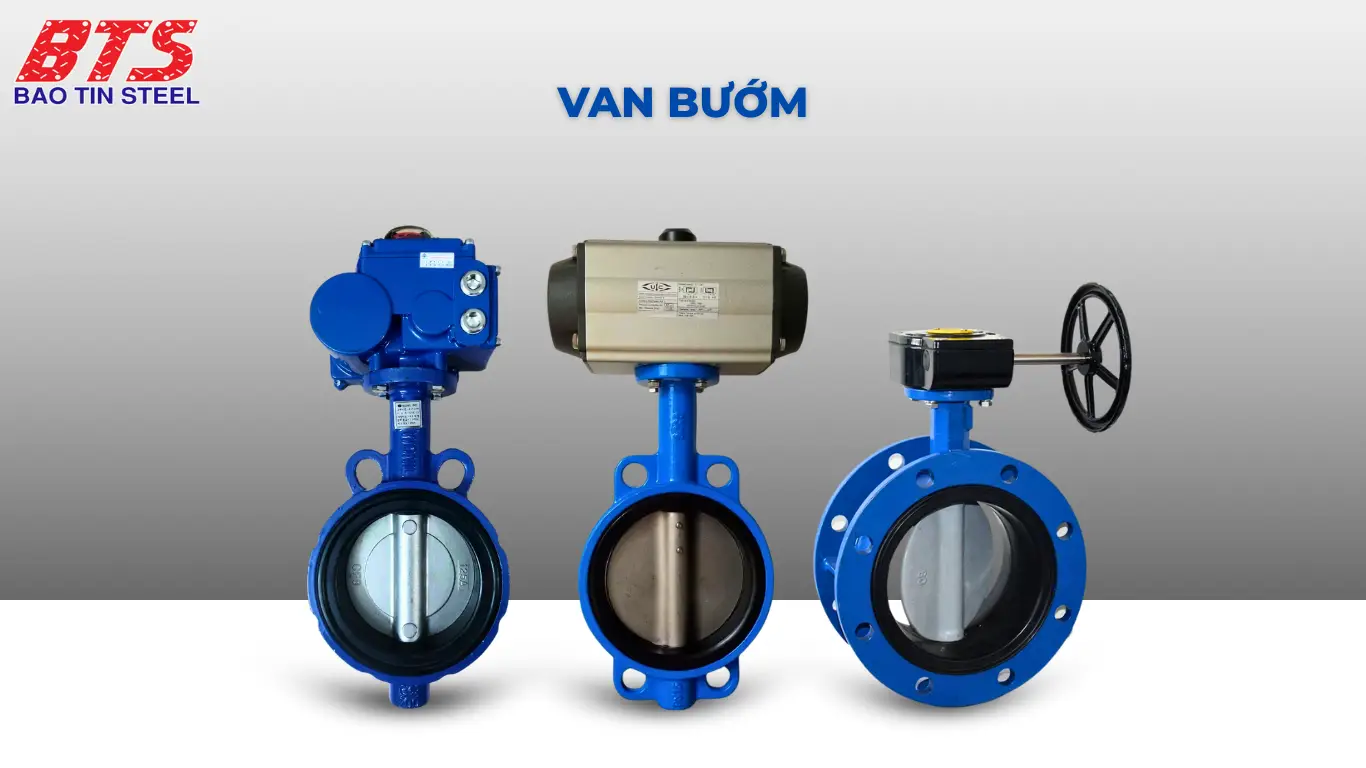
Difference between a gate valve and a butterfly valve
About the composition
Structure is one of the most obvious differences between gate valves and butterfly valves. Although both have the task of controlling flow, the design of each part serves a completely different purpose. Let’s find out the details:

Gate valve structure includes:
- Valve Body: Cylindrical shape, with a large valve chamber to allow the valve disc to move vertically.
- Valve Disc (Gate/Disc): Can be in the form of a hard wedge, soft wedge, or knife-type. It moves up and down to open or close the flow.
- Valve Stem: The shaft connecting the handwheel to the valve disc; can be either a rising stem or a non-rising stem.
- Valve Bonnet: Protects the upper part of the stem and connects to the actuator.
- Sealing Gasket: Made of rubber (EPDM/NBR) or PTFE, preventing leakage when closed.
- Handwheel or Actuator: Used to operate the valve manually or automatically (via electric or pneumatic control).
Butterfly valve structure includes:
- Valve Body: Thin, circular in shape, suitable for wafer, lug, or flanged connections.
- Valve Disc: Circular in shape, located directly within the pipeline, rotating 90° around its axis to control flow.
- Valve Shaft: Transmits motion from the actuator to the valve disc.
- Sealing Gasket: Wrapped around the inner wall of the valve body – typically made of EPDM, PTFE, or metal.
- Lever / Handwheel / Actuator: Directly attached to the valve shaft, allowing rotation of the disc.
Comment:
- Gate valves have a more complex structure, larger size, and require ample space for installation and maintenance.
- Butterfly valves are optimised for compactness and quick operation, making them ideal for tight spaces or applications that require frequent opening and closing.
About the operating principle
The operating principle is a factor that directly affects how the valve operates within the system and its response speed when opening or closing the flow. The difference between gate valves and butterfly valves in terms of operating principles is most apparent in the actuation mechanism and the operation time.

Principle of operation of a gate valve
Gate valves operate via linear motion. When the user rotates the handwheel or activates the actuator:
- The valve shaft rotates, causing the valve disc (or gate) to move vertically, either up or down.
- When the disc is fully raised, the flow passes through the valve in a straight line without obstruction.
- When the disc is lowered, it completely blocks the flow cross-section → fully closed.
Note: Gate valves should not be operated in a partially open state, as high-speed flow can wear down the edges of the disc, causing leakage and reducing the valve’s lifespan.
Operating Principle of Butterfly Valves:
Butterfly valves operate based on a quarter-turn (90-degree) rotational motion:
- When the lever or handwheel is turned, the valve disc rotates around the central axis.
- When the disc is perpendicular to the flow, the valve is fully closed.
- When the disc is parallel to the flow, the valve is fully open, allowing the fluid to pass through with minimal resistance.
- The disc can also be stopped at intermediate positions to regulate the flow.
Comment:
- Gate valves are suitable for systems that require slow and safe opening/closing, and help minimise water hammer effects.
- Butterfly valves are ideal for environments that require quick operation, frequent opening/closing, especially when integrated with electric or pneumatic control.
Regarding size and installation space:
One of the key criteria when selecting a valve for a piping system is the overall size and installation space requirements. In practice, the difference in size between gate valves and butterfly valves is quite noticeable, especially in systems with large diameters or limited installation space.
Gate valve size
- Valve body length (face-to-face): Significantly larger compared to butterfly valves.
- Overall height: Especially large for rising stem gate valves, as the stem rises when opened.
- Weight: Heavier than butterfly valves of the same size due to the thicker design and more mechanical components.
Gate valves take up more vertical space and require a large operating area for handwheel rotation and maintenance disassembly.
Butterfly valve size:
- Valve body length: Very short – butterfly valves are typically only a few centimetres thick, especially the wafer or lug connection types.
- Height and width: Compact and lightweight, suitable for installation on walls, ceilings, or in technical cabinets.
- Weight: Much lighter compared to gate valves, especially in larger sizes from DN200 and above.
Butterfly valves are optimal for tight spaces where gate valves cannot be installed due to height limitations or difficult operating positions.
Pressure and temperature resistance:
When selecting a valve for an industrial system, in addition to design and installation space, an important factor that cannot be overlooked is pressure and temperature resistance. These specifications determine the safety, durability, and application range of the equipment. Below are the differences between gate valves and butterfly valves in this regard:
Gate valves – Better resistance to high pressure and temperature.
- Working pressure: Gate valves typically have a high working pressure range, commonly from PN16 to PN40, and can even reach PN100 with materials like cast steel or stainless steel.
- Working temperature: Depending on the material, gate valves can withstand temperatures ranging from -20°C to over 400°C, making them ideal for high-temperature environments such as steam, thermal oil, compressed air, or industrial solvents.
- Common materials: Cast iron, ductile iron, WCB steel, stainless steel 304/316 – all of which offer excellent resistance to high temperature and pressure.
Gate valves are suitable for systems with strict technical requirements for pressure and temperature, such as boilers, steam generators, hot oil systems, industrial gases, and high-pressure fire protection systems.
Butterfly valves – Have lower pressure and temperature limits.
Working pressure: Typically ranges from PN10 to PN16 for valves made of cast iron, aluminium, or plastic. Some stainless steel butterfly valves can reach PN25, but this is not common.
Working temperature: The limit depends on the sealing gasket. For example:
- EPDM gasket: Up to 120°C
- PTFE (Teflon) gasket: Up to 200°C
- Metal gasket: Up to 300°C, but at a higher cost.
Valve disc design: Always positioned within the flow → directly exposed to pressure and temperature, making it prone to wear if it exceeds the recommended limits.
Butterfly valves should only be used in low-pressure, medium-temperature systems, such as water treatment, air conditioning, or residential pumping stations.
Differences between gate valves and butterfly valves in terms of sealing, durability, and lifespan:
In industrial and residential environments, factors such as sealing, mechanical strength, and operational lifespan play a crucial role, especially in systems with high safety and maintenance requirements. So, how do gate valves and butterfly valves differ in this regard?
Sealing:
- Gate valves: When fully closed, the valve disc lowers and tightly presses against the valve seat, providing excellent sealing. In particular, gate valves with rubber-coated discs or soft wedge designs can achieve almost perfect sealing, effectively minimizing leakage.
- Butterfly valves: The sealing depends on the quality of the sealing gasket (EPDM, PTFE, or metal). While butterfly valves can achieve relatively high sealing performance, prolonged use in environments with high pressure or aggressive chemicals may cause the gasket to wear or deform, leading to slight leakage over time.
Mechanical strength:
- Gate valves: Have a robust structure with the ability to withstand impact, pressure, and heavy loads. Materials such as cast iron, steel, or stainless steel allow the valve to operate reliably under harsh conditions.
- Butterfly valves: Due to their compact design, they have a simpler mechanical structure. The valve disc and shaft are often subjected to direct rotational forces from the handwheel or actuator, making them prone to wear if operated incorrectly or if frequently opened/closed under high pressure.
Operational lifespan
- Gate valves: Have a long operational lifespan, especially if used correctly (only fully opened/closed) and regularly maintained. Some gate valves in water supply systems can operate reliably for 10–15 years.
- Butterfly valves: The lifespan largely depends on the quality of the sealing gasket and the frequency of opening/closing. If used for continuous regulation, the gasket lifespan can be as short as 3–5 years, requiring periodic replacement.
Technical note:
- Gate valves are the preferred choice if you need absolute sealing and long-term durability, especially in critical systems such as fire protection, main water supply, or steam systems.
- Butterfly valves are still suitable when used in the right environment with low pressure, and the gaskets are regularly checked to ensure proper sealing.
Advantages and disadvantages of gate valves and butterfly valves:
To help users easily assess and choose the right equipment, below is a summary table of the advantages and disadvantages of gate valves and butterfly valves. This also serves as the key point to highlight the differences between gate and butterfly valves most concisely and visually.
Advantages and disadvantages of gate valves:
Advantages of gate valves:
- Fully open/close operation, with almost zero pressure loss.
- High sealing performance, suitable for systems requiring absolute isolation.
- Can withstand high pressure and temperature (especially with steel/stainless steel materials).
- Long lifespan if operated correctly.
- Suitable for a wide range of fluids (clean water, gas, steam, oil, etc.).
Disadvantages of gate valves:
- Slow opening/closing, requiring multiple rotations.
- Large size, taking up more installation space.
- Not suitable for flow regulation.
- Maintenance and replacement of parts are time-consuming.
- Higher initial cost compared to butterfly valves.
Advantages of butterfly valves:
Advantages of butterfly valves:
- Compact and lightweight, easy to install in tight spaces or wall-mounted.
- Quick opening/closing (quarter-turn rotation).
- Can regulate flow (at low to medium pressure).
- Cost-effective with low maintenance costs.
- Flexible connection options: wafer, lug, flange.
Disadvantages of butterfly valves:
- The valve disc is in the flow path → causing pressure loss.
- Sealing performance depends on the gasket, and it can be affected when used with chemicals or high temperatures.
- Not suitable for high-pressure environments or thick fluids.
- Gaskets must be replaced periodically if the valve is frequently opened and closed.
Practical applications of gate valves and butterfly valves
To choose the right valve for your system, it’s essential to understand the practical applications of gate valves and butterfly valves. While both are used for flow control, each type of valve performs optimally in very different conditions. Below is a detailed analysis of the differences between gate and butterfly valves in terms of application, broken down by industry and operating environment.
Applications of gate valves:
Gate valves are typically preferred in systems that require full open/close operation, operate at high pressure and temperature, or where absolute sealing is essential.
Typical fields of application:
- Water supply and water treatment systems: Especially in main pipelines, where complete isolation of flow is required.
- Fire protection (PCCC): OS&Y (Outside Screw & Yoke) gate valves are required by many NFPA/UL/FM standards.
- Oil, gas, and chemicals industries: Steel/stainless steel gate valves are used in hot oil systems, solvents, gasoline, natural gas, etc.
- Thermal and hydroelectric power plants: For controlling steam, boiler feedwater, or high-temperature fluids.
- Mining, cement, and slurry systems: Knife gate valves are suitable for cutting through fluids containing solid particles, thick slurries, etc.

Applications of butterfly valves:
Butterfly valves are widely used due to their compact design, quick opening/closing, and low cost. This type of valve is particularly suitable for medium to low-pressure systems, where flexible installation and frequent operation are required.
Main fields of application:
- Wastewater and drinking water treatment: Cast iron or stainless steel butterfly valves are common in water treatment plants.
- HVAC systems – industrial air conditioning: Efficiently regulate the flow of cooling water/chilled water.
- Food, beverage, and pharmaceutical industries: Stainless steel sanitary butterfly valves used in CIP systems and clean pipelines.
- Light chemical plants, dilute solutions: PTFE butterfly valves used for blocking or regulating mild acids.
- Residential pumping stations and high-rise buildings: Easily mounted on suspended or ceiling pipelines.

In summary:
- Gate valves are suitable for critical systems that require high sealing performance, pressure, temperature resistance, and safety.
- Butterfly valves are an economical, flexible choice, easy to install and operate, especially in tight spaces or systems that require frequent flow regulation.
Cost and operating expenses of gate valves and butterfly valves:
In addition to technical factors, the initial purchase price and operating costs are also important criteria that influence investment decisions. Below is the financial comparison between gate valves and butterfly valves, including investment costs, maintenance, and lifespan.
Initial purchase price:
- Butterfly valves: They are significantly cheaper than gate valves of the same size. Thanks to their simple design, fewer materials, and ease of manufacturing, butterfly valves are often the optimal choice when the budget is limited. For example, a DN100 cast iron butterfly valve may cost only 40-60% of the price of a DN100 cast iron gate valve.
- Gate valves: The cost is higher due to their more complex design, larger size, and the need for more materials. Specifically, electric signal gate valves (OS&Y) or those made of steel/stainless steel are quite expensive and are suited for specialised systems.
Operating and maintenance costs:
| Criteria | Gate Valve | Butterfly Valve |
|---|---|---|
| Routine maintenance cost | Higher – complex disassembly requires technical skills | Lower – easy disassembly, simple gasket replacement |
| Spare parts | Disc, stem, gasket – expensive, hard to find standard parts | Mainly gasket – easy to replace, low cost |
| Replacement cost | High (due to weight and complex disassembly) | Low, can be quickly replaced at a low cost |
| Device lifespan | Long-lasting if infrequent opening/closing and proper maintenance | Average lifespan – requires periodic gasket replacement |
Total life-cycle cost:
- Gate valves: Although the initial investment is high, if not frequently opened/closed and used in the right environment, the long lifespan helps save costs in the long run. However, replacement and repair costs may be high if operated incorrectly or in environments with sediment or solid particles.
- Butterfly valves: The life-cycle cost is lower, making them suitable for systems with high operation frequency or where bulk installation is required with a limited budget. However, if the gasket is not replaced regularly, minor leaks may occur after 3-5 years of use.
Should you choose a gate valve or a butterfly valve?
Having analysed in detail the differences between gate valves and butterfly valves through technical, economic and application criteria, the most important question is: which type of valve is suitable for your system?
The answer has no common denominator, but depends on the specific usage environment, technical requirements and investment budget. Below are some suggestions for choosing valves according to common cases:
Fire protection system
- Recommended: OS&Y gate valve (rising stem), UL/FM certified. Reason: High tightness, easy to observe valve status, by NFPA standards.
- Butterfly valve: Can be used for small sprinkler systems, but needs to ensure appropriate certification if the project has strict requirements
Clean water supply system – domestic water
- Gate valve: Used for main pipelines, pumping stations, where complete flow isolation is required
- Butterfly valve: Used for branches, layered pipelines, where quick operation is required, narrow spaces
Hot oil – hot steam – high-pressure system
- Choose steel or stainless steel gate valves
- Butterfly valves are not recommended because they are prone to leakage due to limited heat and pressure resistance
HVAC system – air conditioning – chilled water
- Should choose: Butterfly valve
- Reason: Compact, easy to regulate flow, installed in technical ceilings, electrical cabinets, air ducts…
Chemical system – wastewater treatment
- Stainless steel gate valve or knife valve: Used for mud flow, water with solid particles
- PTFE coated butterfly valve: Good for mild acid, domestic wastewater, dilute chemicals
Food, beverage, and pharmaceutical industry
- Sanitary stainless steel butterfly valves are popular thanks to their hygienic design, easy CIP/SIP cleaning, and space-saving.
Bao Tin Steel – A reputable industrial valve supplier
Once you understand the difference between gate valves and butterfly valves, the next step is to choose a reputable supplier, ensuring products meet technical standards, have full documentation and long-term technical support.
Bao Tin Steel Company Limited is proud to be an authorised distributor of genuine industrial valves, specialising in providing the following lines:
- Valves: Cast iron, steel, stainless steel; rising stem, non-rising stem; UL/FM electric signal valves for fire protection systems (FSS)
- Butterfly valves: Lever-operated, gear-operated, electric or pneumatic actuated; made from a variety of materials, from cast iron to sanitary stainless steel
- Complete with accessories: Flanges, gaskets, bolts, pressure gauges, Y-strainers, etc.
Why choose Bao Tín Steel?
- Genuine products from reputable brands: Wonil, AUT, ROBO, Shin Yi, DHC, Emico…
- Competitive pricing – flexible based on project scale
- An expert technical consultation team to help choose the right valve standards
- Available stock in Ho Chi Minh City and Cambodia – fast nationwide delivery
- Clear warranty policy and support for returns in case of technical defects
Are you looking to choose the right gate valve or butterfly valve for your water supply, fire protection (FSS), pneumatic, or chemical systems?
Call our hotline now 0932 059 176 hoặc email: kinhdoanh@thepbaotin.com
Tiger Steel is a subsidiary of Bao Tin Steel.