

 Tiếng Việt
 ភាសាខ្មែរ
Not only is the stainless steel butterfly valve renowned for its durability and long lifespan, but it is also highly appreciated for its ability to withstand pressure and temperature, ease of maintenance, and cost-effectiveness in operation. So, what makes this valve so special? How many types exist, and in which scenarios should they be used?
Let’s explore the definition, structure, advantages, classifications, price list, and real-world applications of stainless steel butterfly valves in the following article by Bao Tin Steel.
What is a stainless steel butterfly valve?
A stainless steel butterfly valve (also known as a stainless steel butterfly valve in English) is a type of butterfly valve with its entire body made from materials such as stainless steel 201, 304, or 316, providing high durability and exceptional corrosion resistance. The disc and shaft are typically made from stainless steel 316, combined with Teflon sealing gaskets to ensure good heat and chemical resistance.
Stainless steel butterfly valves are used to regulate the flow of liquids in piping systems that require high temperatures, high pressure, corrosive chemicals, industrial wastewater, and more.

Basic Technical Specifications of Stainless Steel Butterfly Valves
- Dimensions: DN50 – DN250
- Body Material: Stainless Steel 201, 304, 316
- Disc and Shaft: Stainless Steel
- Sealing Gasket: PTFE, EPDM, Teflon, etc.
- Control Type: Lever, handwheel, electric actuator, pneumatic actuator
- Working Pressure: 10 bar
- Operating Temperature: -25ºC ~ 180ºC
- Connection Type: Flanged, wafer (clamped), clamp
- Standards: JIS, BS, DIN, ANSI
- Environment: Compressed air, chemicals, water, steam, etc.
- Origin: Malaysia, South Korea, Taiwan, Japan, Turkey, etc.
- Brand: YDK, Wonil, JS, ARV, ShinYi, ETM, Samwoo, Robo, etc.
Structure and operating principle

A stainless steel butterfly valve has a simple structure, consisting of 5 main components:
- Valve Body:
Made from cast stainless steel (typically SUS201/304/316), the body is designed with wafer, lug, or flanged connections, depending on the type of installation. - Valve Disc:
The disc is round and rotates around the shaft. It is also made from stainless steel (usually 304 or 316), and it’s the main component that controls the flow. - Valve Shaft:
The shaft transmits force from the actuator to the valve disc, enabling it to rotate and regulate the flow of fluid. - Sealing Gasket:
Usually made from EPDM, PTFE, or metal, the sealing gasket ensures the valve remains leak-proof and maintains tight sealing to prevent fluid leakage. - Actuator:
The actuator can be a lever, handwheel, or automatic control system using electric or pneumatic power, depending on the type of valve operation required.
Operating Principle:
When the lever is turned or the actuator is activated, the valve disc rotates 90° to either open or close the flow. It can also stop at intermediate positions to regulate the flow rate.

Common Types of Stainless Steel Materials
| Stainless Steel Type | Key Characteristics | Suitable Applications |
|---|---|---|
| 304 Stainless Steel | Popular, cost-effective, and good corrosion resistance in clean water | Water systems, food processing, HVAC, wastewater |
| 316 Stainless Steel | Higher corrosion resistance, withstands strong chemicals | Chemicals, saltwater, pharmaceuticals, acidic environments |
| 201 Stainless Steel | More affordable, lower corrosion resistance | Suitable only for clean water, not recommended for chemicals |
Note: For special environments such as seawater, strong acids, or solvents, it is recommended to prioritise 316 or 316L stainless steel to ensure durability.
Outstanding advantages of stainless steel butterfly valves
Stainless steel butterfly valves not only stand out for their compact design but also win users over with a range of superior features, including durability, corrosion resistance, and operational efficiency. Below are the key advantages of this valve type:
Corrosion Resistance – Suitable for Harsh Environments
- With being made from 304, 316, or 316L stainless steel, stainless steel butterfly valves have excellent resistance to chemical corrosion, oxidation, and electrolytic corrosion. This allows the valve to operate reliably in environments containing acids, alkalies, saltwater, chemicals, or high humidity conditions where cast iron or carbon steel valves typically fail to perform.
High Lifespan – Good Mechanical Durability
- Stainless steel is a material with high hardness, capable of withstanding high pressure and high temperatures without deformation. As a result, stainless steel butterfly valves have a significantly longer lifespan compared to plastic or cast iron valves, especially when properly installed and regularly maintained.
Easy Operation and Maintenance
- With a 90-degree disc rotation design, stainless steel butterfly valves are easy to open and close quickly using a lever, handwheel, or automatic actuator. Additionally, their simple structure makes it easier to perform maintenance, gasket replacement, or periodic inspections compared to more complex valves like gate valves or globe valves.
=> See More: The Difference Between Gate Valves and Butterfly Valves
Diverse Applications
Not only used in clean water treatment, stainless steel butterfly valves are also widely used in:
- Chemical Industry
- Food, Beverage, Pharmaceutical Industry
- Steam – Hot Water Systems
- Wastewater Treatment
With a series of advantages above, stainless steel butterfly valves are the comprehensive solution for systems requiring high performance and low maintenance costs.
Types of stainless steel butterfly valves on the market
On the market today, stainless steel butterfly valves are categorised based on their operating method and specific application. Depending on the technical characteristics of the system and control needs, users can choose the appropriate valve type below:
Stainless steel butterfly valve with lever
- Features: Open/close by 1/4 turn (90-degree) lever, with fixed position lock.
- Popular sizes: DN50 – DN150.
- Advantages: Compact, low cost, quick operation.
- Applications: Civil systems, water treatment, systems with little opening/closing.
Suitable for small systems or where valve operation is frequent and easily accessible.

Stainless steel butterfly valve with handwheel (gearbox)
- Features: Use the steering wheel combined with the power gearbox to open/close the valve disc.
- Popular size: DN100 and above (especially from DN200 – DN300).
- Advantages: Easy to operate at a large size, safe, and reduces hand force.
- Applications: Water treatment plant, chemical system, and steam.
Suitable for large pipelines where stable flow control and reduced operator fatigue are required.
=> Learn more about handwheel butterfly valves

Electric control stainless steel butterfly valve
- Features: Automatic opening/closing via electric motor, with remote control signal (ON/OFF or linear).
- Voltage options: 24V, 220V, 380V.
- Advantages: Automation, precise control, SCADA/BMS connection.
- Applications: Smart systems, automatic factory, machine room, and fire protection.
Suitable for systems requiring remote monitoring or opening/closing, or in hazardous environments.

=> See more: Electric control butterfly valve
Pneumatic control stainless steel butterfly valve
- Features: Uses pneumatic pressure to open/close quickly.
- Options: Single action (spring return) or double action.
- Advantages: Fast response, high durability, safe operation in explosive environments.
- Applications: Chemical industry, beverage production, hot steam.
Ideal for automated lines requiring high response speed and accuracy.

Stainless steel sanitary butterfly valve
- Features: Designed according to hygiene standards (CIP/SIP), mirror-polished surface.
- Material: Stainless steel 316L, food-safe EPDM or PTFE gasket.
- Advantages: Anti-stick, easy to clean, does not affect product quality.
- Application: Dairy, beer, beverage, pharmaceutical, cosmetic industries.
A must-have for industries requiring strict hygiene standards.

Please refer to some butterfly valves at Bao Tin Steel:
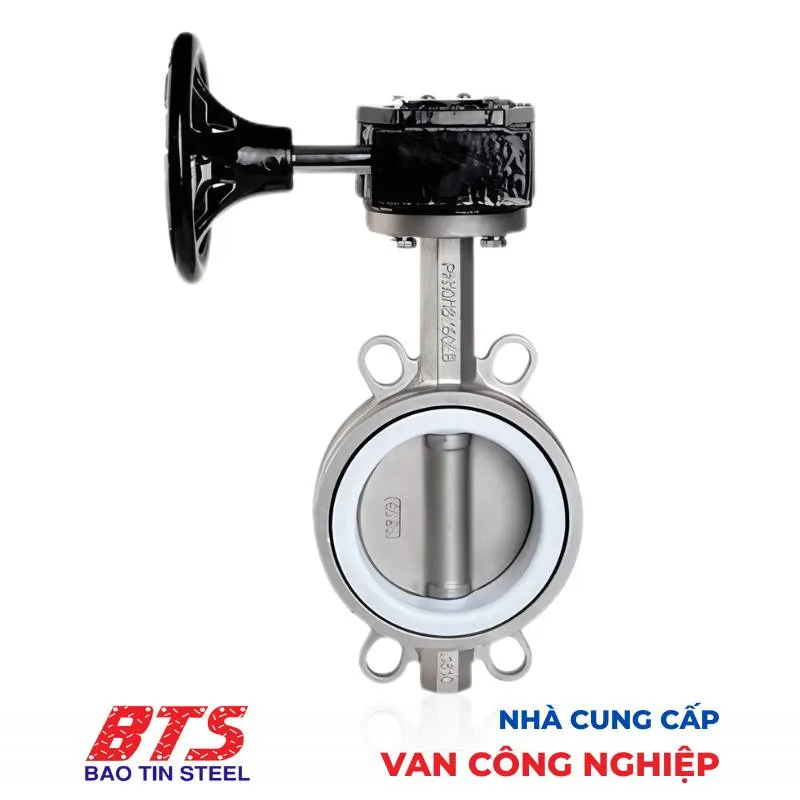

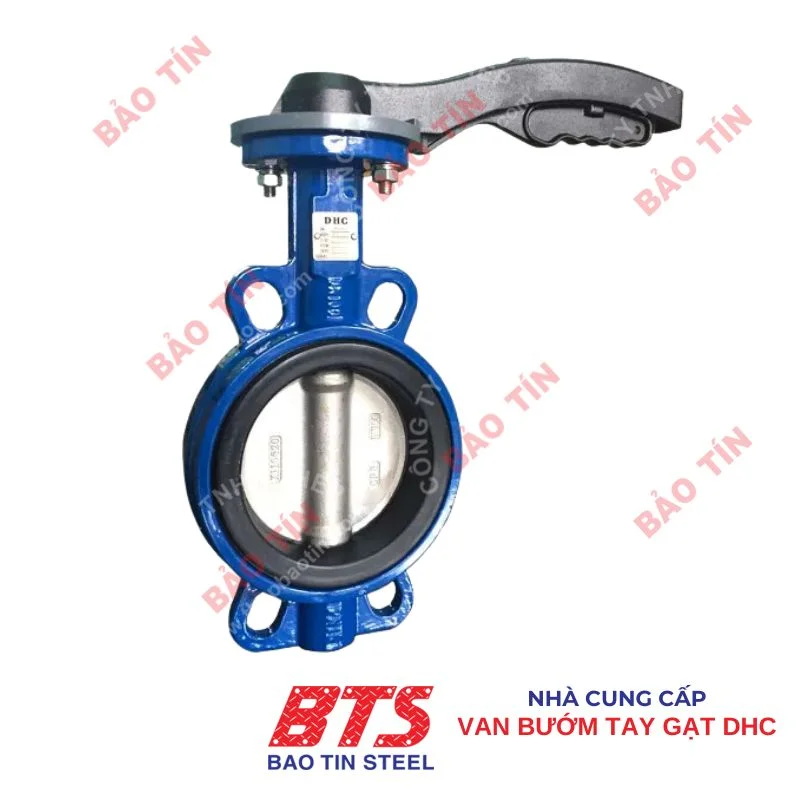
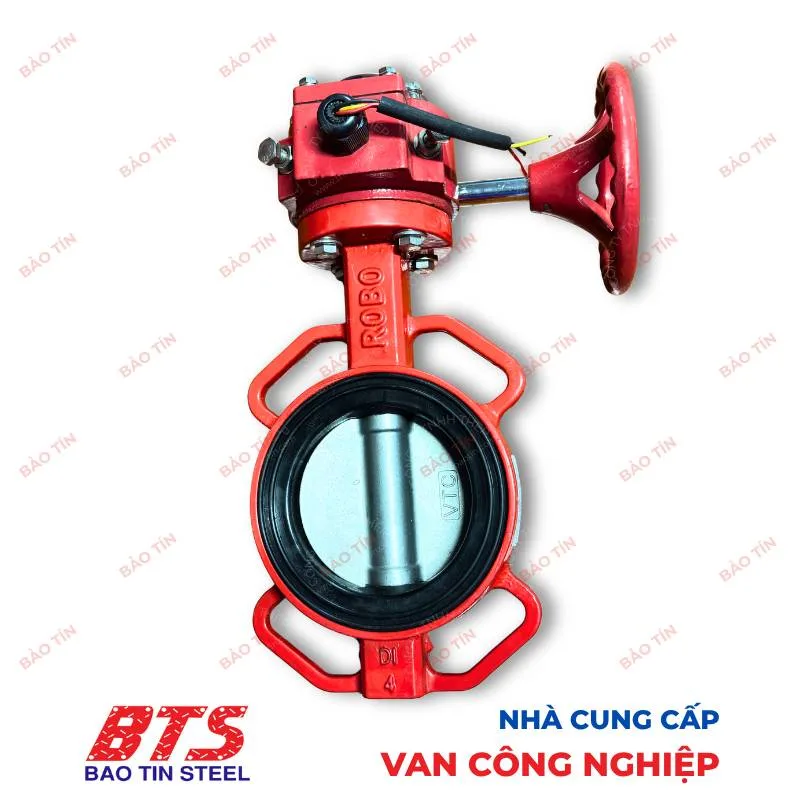
Practical application of stainless steel butterfly valves
With outstanding anti-corrosion properties, high-pressure and temperature resistance, stainless steel butterfly valves are increasingly widely used in technical systems requiring stable performance and high durability. Below are typical industries and environments where stainless steel butterfly valves maximise their advantages:
Wastewater treatment – chemicals
- Stainless steel butterfly valves (especially 316 stainless steel or PTFE coated) are resistant to acids, bases, salt water, and cleaning solutions, helping the equipment operate durably in harsh environmental conditions.
- Commonly installed in chemical tanks, pH neutralisation tanks, corrosive solution pipelines, and industrial wastewater treatment plants.
Commonly used valve types: Stainless steel butterfly valve with handwheel or pneumatic control
Food – beverage – pharmaceutical
- Stainless steel sanitary butterfly valve meets hygiene standards, is easy to clean CIP/SIP, and does not cause cross-contamination.
- Used in production lines of beer, purified water, soft drinks, milk, injections, cosmetics, etc.
- The inner surface is mirror-polished to prevent residue and is easy to wash away.
Commonly used valve type: 316L stainless steel sanitary butterfly valve – electric or hand lever control
Oil & Gas – Petrochemical Filtration
- They are used to control the flow of steam, crude oil, fuels, compressed air, and volatile solvents.
- Stainless steel butterfly valves help reduce the risk of leakage, ensuring safety for high-pressure operating systems.
- These valves are commonly used in refineries, fuel storage tanks, and gas distribution stations.
Commonly Used Type: Pneumatically Controlled Stainless Steel Butterfly Valve – steel body, 316 stainless steel disc.
Electric Power – Thermal Power Industry
- Stainless steel butterfly valves are used in turbine cooling systems, regulating boiler feedwater, controlling steam, and circulating water.
The advantage of these valves lies in their ability to withstand high temperatures and high pressure, without oxidation during continuous operation.
Commonly Used Type: Stainless steel butterfly valves with handwheels or electric actuators, large sizes (DN200 – DN300).
Shipbuilding – Marine Ports
- In the highly corrosive marine environment, stainless steel butterfly valves are a mandatory choice.
- They are used in engine cooling systems, seawater piping, and for ballast water or sewage treatment.
Commonly Used Type: 316 stainless steel butterfly valves, flanged, with either handwheel or automatic control.
Comparing Stainless Steel Butterfly Valves with Other Types of Valves
Stainless steel butterfly valves are renowned for their corrosion resistance and high durability, but are they the optimal choice in every case? Below is a comparison table between stainless steel butterfly valves, cast iron valves, steel valves, and plastic valves, considering key technical criteria and practical applications.
Overview Comparison Table
| Criteria | Stainless Steel Butterfly Valve | Cast Iron Butterfly Valve | Plastic Butterfly Valve | Steel Butterfly Valve |
|---|---|---|---|---|
| Corrosion Resistance | Excellent (especially with 316 stainless steel) | Moderate – prone to rust | Good with mild chemicals, poor outdoors | Good with clean water, poor with strong chemicals |
| High Temperature Resistance | Good (up to 200–300°C depending on gasket type) | Fairly good (100–150°C) | Poor (<60–90°C depending on PVC/UPVC/CPVC) | Excellent (over 300°C with alloy steel) |
| Lifespan – Mechanical Durability | Very high – strong and durable | High, but heavy | Low – prone to cracking or breaking on impact | Very high – strong, good load resistance |
| Weight – Installation | Lighter than steel, heavier than plastic/cast iron | Heavy | Very light – easy to install | Heavy – requires support for larger sizes |
| Investment Cost | Moderate to high (depending on stainless type) | Low – common | Cheapest | High – especially with cast steel or alloy steel |
| Recommended Applications | Chemicals, food, seawater, pharmaceuticals | Clean water systems, HVAC, fire protection | Mild water treatment, pools, low-pressure systems | Hot steam, oil, compressed air, and industrial plants |
When should you choose stainless steel butterfly valves?
You should prioritise choosing stainless steel butterfly valves when:
- Your system operates in environments with strong chemicals, saltwater, corrosive solvents, or high temperatures.
- Strict hygiene requirements are necessary, such as in the food, beverage, and pharmaceutical industries.
- A high lifespan and long-term stability are essential, especially in production lines where frequent shutdowns for maintenance are not feasible.
- The installation space is limited but requires corrosion-resistant and mechanically durable materials.
Note: If your budget is limited and the operating environment involves clean water, drinking water, or non-corrosive gases, you may consider opting for cast iron or plastic valves to save costs.
Latest Price List for Stainless Steel Butterfly Valves (FOR REFERENCE)
The Price of Stainless Steel Butterfly Valves in the current market varies widely, depending on several factors such as nominal size (DN), actuation type (lever, handwheel, electric, pneumatic), stainless steel material (304, 316, 201), and brand.
Below is a reference price list for commonly used stainless steel butterfly valves in Vietnam (updated for 2025), applicable for wafer connection and EPDM seals:
Price list of stainless steel butterfly valves with lever and handwheel (Stainless Steel 304)
| Nominal Size (DN) | Lever Operated Valve (VND/unit) | Handwheel Operated Valve (VND/unit) |
|---|---|---|
| DN50 | 890,000 – 1,100,000 | 1,250,000 – 1,450,000 |
| DN65 | 1,050,000 – 1,300,000 | 1,500,000 – 1,700,000 |
| DN80 | 1,200,000 – 1,450,000 | 1,650,000 – 1,900,000 |
| DN100 | 1,500,000 – 1,800,000 | 1,950,000 – 2,300,000 |
| DN125 | 2,100,000 – 2,400,000 | 2,500,000 – 2,900,000 |
| DN150 | 2,400,000 – 2,800,000 | 3,000,000 – 3,400,000 |
| DN200 | 3,000,000 – 3,700,000 | 4,000,000 – 4,500,000 |
| DN250 and above | Contact for pricing | Contact for pricing |
Electric & pneumatic control stainless steel butterfly valve price
| Actuation Type | Common Size | Reference Price (VND/unit) |
|---|---|---|
| Electric ON/OFF Control | DN50 – DN150 | 3,500,000 – 8,000,000 |
| Electric Linear Control | DN50 – DN150 | 6,500,000 – 10,000,000 |
| Pneumatic Single Acting | DN50 – DN150 | 3,800,000 – 7,500,000 |
| Pneumatic Double Acting | DN50 – DN150 | 4,200,000 – 8,500,000 |
Note: The prices may vary depending on the brand (AUT, Jaki, Hershey, Wonil, etc.), origin (South Korea, Taiwan, China, Europe), and material used (Inox 304, 316).
=> See more: Latest butterfly valve price list 2025
Factors affecting the price of stainless steel butterfly valves
| Factor | Impact on Price |
|---|---|
| Body & Disc Material | Inox 316 is about 20–30% more expensive than 304 due to its superior corrosion resistance. |
| Actuation Type | Electric or pneumatic control valves are more expensive than lever-operated valves. |
| Valve Size (DN) | Larger sizes from DN200 and above increase in price exponentially. |
| Seal Type | PTFE, Viton, or metal seals are more expensive than EPDM seals. |
| Standards & Certifications | Valves with CO, CQ, UL/FM, and ISO certifications are priced higher than non-certified products. |
| Brand & Origin | Korean, Japanese, and European brands are more expensive than Chinese valves. |
Experience in choosing stainless steel butterfly valves
Choosing a stainless steel butterfly valve is not only based on price but also on many technical factors and specific usage conditions. Below are some practical tips to help you choose the right valve – durable and cost-effective in the long run.
Choose the right valve type according to the usage environment
| Working Environment | Recommended Valve Type |
|---|---|
| Strong chemicals, saltwater | Inox 316 or 316L, PTFE or Viton seals |
| Clean water, drinking water | Inox 304, EPDM seals |
| Hot steam, thermal oil | Inox 304 or alloy steel, metal seals |
| Food, pharmaceuticals, drinking water | Sanitary Inox 316L, mirror-polished surface |
| Industrial wastewater treatment | Inox 304/316, solid disc, wear-resistant seals |
Note: The harsher the environment, the more you should choose higher quality stainless steel (316 or above) and appropriate seals.
Check Technical Standards
- Working pressure (PN): Ensure the valve can withstand the pressure in the system – usually choose PN10 to PN25.
- Working temperature: Check the temperature limit of the gasket (EPDM ~120°C, PTFE ~200°C…).
- Connection type: Wafer, lug, flange – must be synchronised with the existing pipe flange.
- Control mode: Choose lever, handwheel, electric or pneumatic control depending on the operating frequency and automation system.
Attention to Seal Material
Gaskets are the deciding factor in valve seal and life. Some popular options:
| Seal Type | Characteristics | Suitable Applications |
|---|---|---|
| EPDM | Affordable, heat resistant up to 120°C, not resistant to oils | Clean water, wastewater, gases |
| PTFE (Teflon) | Excellent resistance to strong chemicals, heat resistance up to 200°C | Chemicals, solvents, steam |
| Viton | Excellent oil resistance, good for mild acids, and high-temperature resistance | Oil & gas, organic solvents |
| Metal | High mechanical strength, suitable for high-pressure steam and heat | Power plants, steam systems |
Check the Origin & Technical Documents
To ensure quality, when buying stainless steel butterfly valves, you should fully request:
- CO (Certificate of Origin): Certificate of Origin
- CQ (Certificate of Quality): Certificate of Quality
- Catalogue, datasheet, technical drawings
- Clear Brand Name: Prefer valves from reputable brands such as Wonil, Emico, AUT, Hershey, Jaki, etc.
Avoid buying unlabeled, uncertified valves – easily damaged, with no replaceable parts
Bao Tin Steel – A reputable supplier of butterfly valves
If you are looking for a supplier of high-quality, affordable, and readily available stainless steel butterfly valves, then Thép Bảo Tín is the trusted partner for you.
With over 10 years of experience in the industrial valve and pipeline materials supply sector, Bao Tin Steel has become a reputable distributor of leading valve brands such as Wonil (South Korea), AUT, Hershey, Jaki, as well as stainless steel valves imported from China, Taiwan, and Europe.
We are committed to providing high-quality butterfly valves and industrial valves with full documentation, including CO-CQ certificates, clear inspection reports, and transparent origin details.
All products are directly imported from top manufacturing plants such as:
- Korea: Samwoo, YDK, Wonil
- Malaysia: AUT, ARV
- Taiwan: Shin Yi
- China: JS, ETM
- Vietnam: Robo, Emico…
Commitment to 100% genuine products, new, intact when delivered to customers.
Why should you choose stainless steel butterfly valves at Bao Tin Steel?
- Diverse Products, In Stock: From DN50 to DN300, available in various types of manual lever, manual wheel – electric/pneumatic control.
- Quality Assurance: Full documentation including CO-CQ certificates, test reports, and technical drawings included.
- Competitive Pricing – Good Discounts: Flexible pricing based on quantity, projects, and installation units.
- Free Technical Consultation: Assistance in choosing the right stainless steel material, control type, and connection type.
- Fast Nationwide Delivery: Warehouse system in Ho Chi Minh City, Bac Ninh, with professional logistics services.
Currently, the stainless steel butterfly valve series (304 – 316 – sanitary) is on display and ready for immediate delivery at Bao Tin Steel’s warehouse. If you need advice on selecting the right product, detailed pricing, or technical documents, please contact us immediately:
Hotline / Zalo: 0932 059 176 – Email: kinhdoanh@thepbaotin.com
Tiger Steel is a subsidiary of Bao Tin Steel.