

 Tiếng Việt
 ភាសាខ្មែរ
Flange types differ due to the different service conditions under which they operate. Flanges are selected based on anti-corrosion properties, anti-erosion properties, pressure temperature rating, number of welds required for attachment, physical dimensions (some flange designs may not fit space permitting), and cost.
Some types of flanges commonly used on the market include:
- Welding Neck flange
- Slip On flange
- Threaded flange
- Blind flanges
- Socket Weld flange
- Lap Joint flange
Below, Bao Tin Steel will provide a short description and definition of each type, adding a detailed photo to make it easier to visualize.
Types of flanges on the market
Flanges help connect pipes to various devices and valves. People can classify flanges based on materials such as steel, stainless, cast iron, etc. In addition, the names of flanges depend on the flange structure. So we will have:
Welding Neck flange
The weld neck flange is easy to identify thanks to its long weld neck. This weld neck part will be gradually equal to the thickness of the steel pipe or weld fittings.
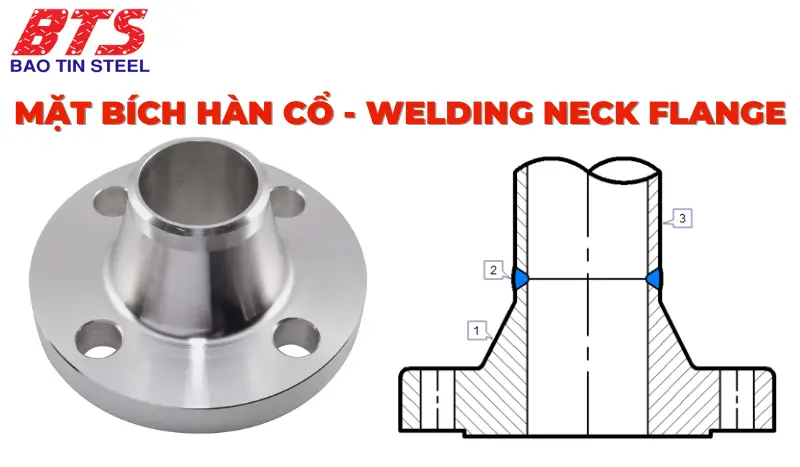
It is also extremely useful in several applications related to:
- High pressure
- Low temperature below 0 degrees Celsius
- High temperature
The transition process between steel pipe sections or between pipes and accessories, between pipes and valves, etc. takes place smoothly from flange thickness to pipe wall thickness.
This is partly due to the specially designed weld neck slope. This design ensures the flange performs well under conditions of repeated bending due to pipeline expansion or other changing forces. At the same time, it also reduces pressure at the welding point and creates a larger weldable area.
Weld neck flanges are bored to fit the inside diameter of the pipe or fitting. So it will not restrict the flow of fluid inside the pipe.
This helps prevent vortices at the joint and reduces erosion at the contact point. At the same time, ensuring stress distribution in the system minimizes cavitation phenomena.
Besides, thanks to this design, checking for internal defects is also easier. Through methods such as X-ray,…

Weld neck flange connection details:
- Weld neck flange
- Weld
- Steel pipes or welded fittings
Slip On flange
The calculated strength of the upper sliding weld flange under internal pressure is 2/3 of that of the weld neck flange. At the same time, their lifespan is about 1/3 that of weld neck flanges.
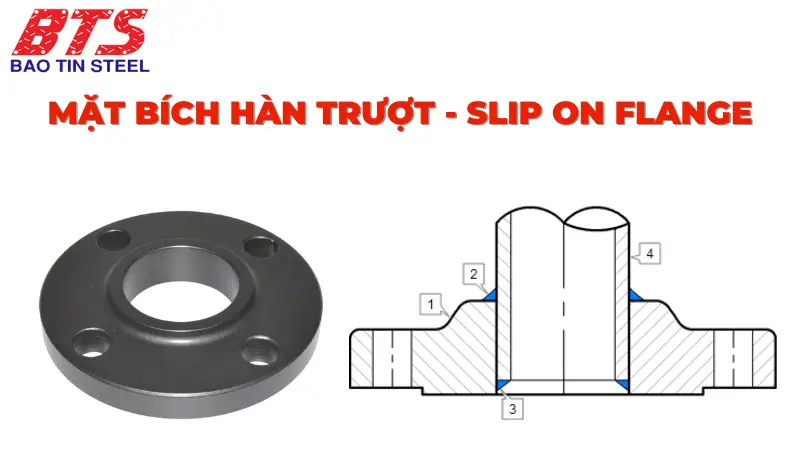
To connect Slip-On flange types to pipes, the construction worker will have to weld at 2 locations, which are:
- Inside flange
- Outside flange
Readers can take a closer look at Figure 2 below. The location of the welds is indicated in blue on the drawing.
The distance between the inner welding point of the flange and the flange surface (position 3 in the photo) is approximately equal to the pipe wall thickness + 3mm.
This clearance is necessary so as not to damage the flange during the welding process.
Slip-on flanges are typically used in low-pressure or lower-temperature applications than welding neck flanges. It is also used in applications where pipes have variable lengths and require flexibility during installation and removal.
However, slip-on flanges have a drawback. That is when connecting, the flange must first be welded to the pipe, and then the joint must be welded. It cannot be combined with steel elbows, because these accessories do not have straight ends.
Details about Slip On flange:
- Slip On flange
- Full weld on the outside
- Full weld inside
- Pipeline
Socket Weld flange
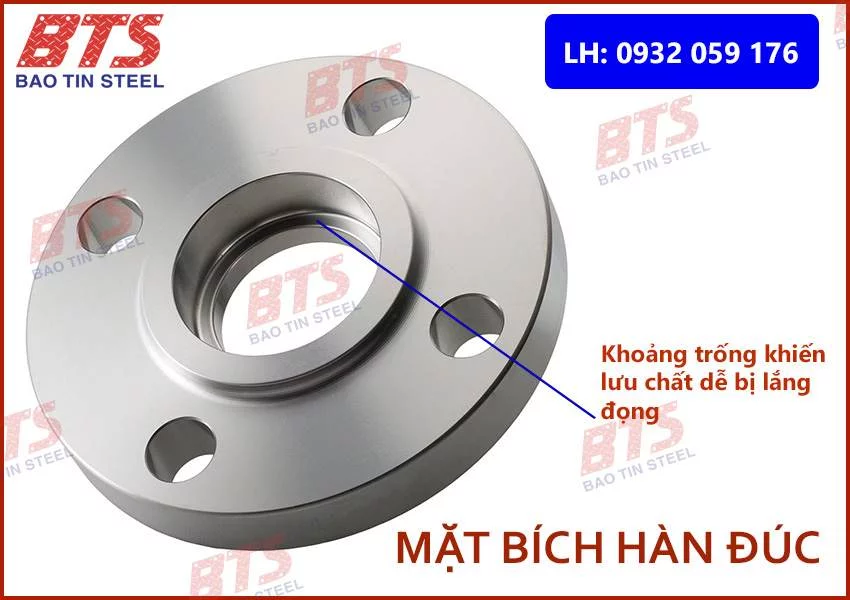
Socket Weld flanges were originally developed for use on small-sized, high-pressure piping. Their static strength is equal to the Slip-On flange, but their fatigue strength is 50% greater than that of the slip-on flange.
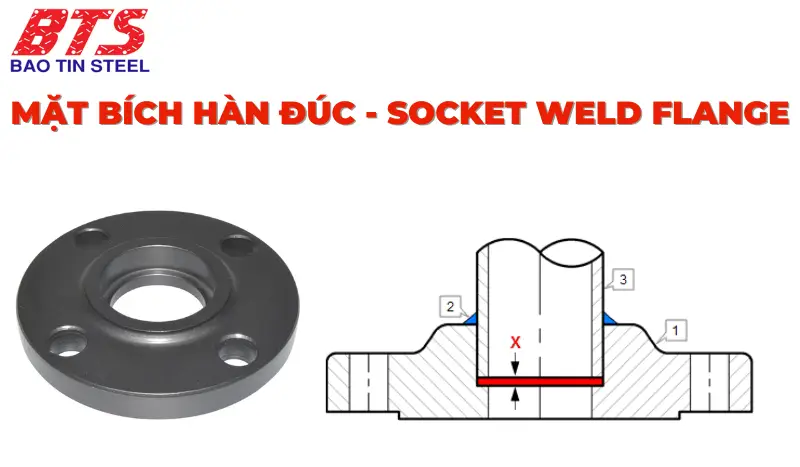
The connection to the pipe is made by a fillet weld on the outside of the flange. But before welding, a space must be created between the flange and the fitting or pipe.
This regulation is mentioned in standard ASME B31.1-1998, section 127.3. Readers can read to understand more.
When installing socket weld flanges into pipes, first install them to the maximum depth of the flange, then pull them out at a distance of 1.6 mm (X symbol in the image).
The purpose of the bottom gap in a hole weld is usually to reduce residual stress at the root of the weld. This phenomenon can often occur during the solidification of the weld metal.
However, this space also has a disadvantage, which is that it is susceptible to fluid deposition. Over time, it will lead to corrosion, so you need to pay attention when choosing flanges.
Details about socket weld flanges:
- Socket Weld flanges
- Full weld on the outside
- Pipeline
- X = Extension distance
Lap Joint flange
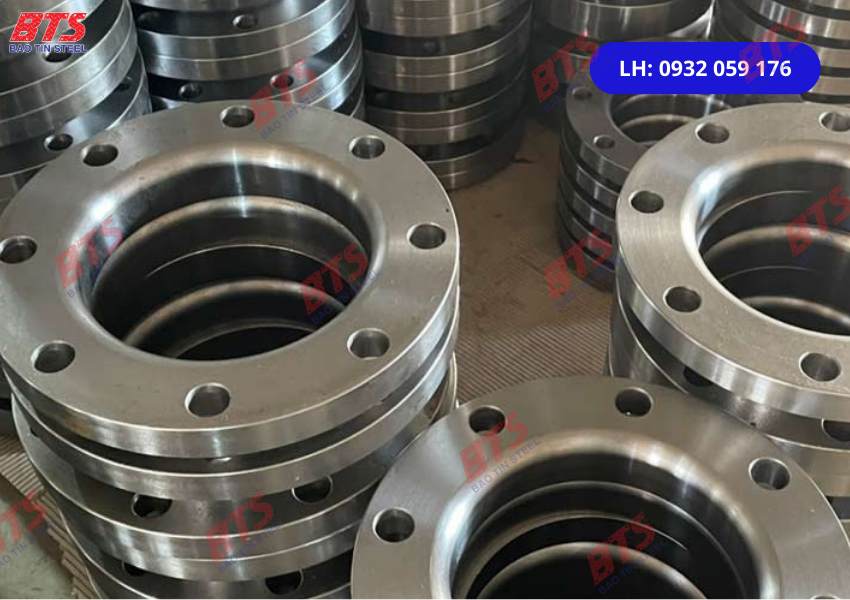
The Lap Joint flange has all the same general dimensions as any other flange named in this article. It is also one of the most common types of flanges. However, its surface is not raised, and when connected, it usually comes with a stub end.
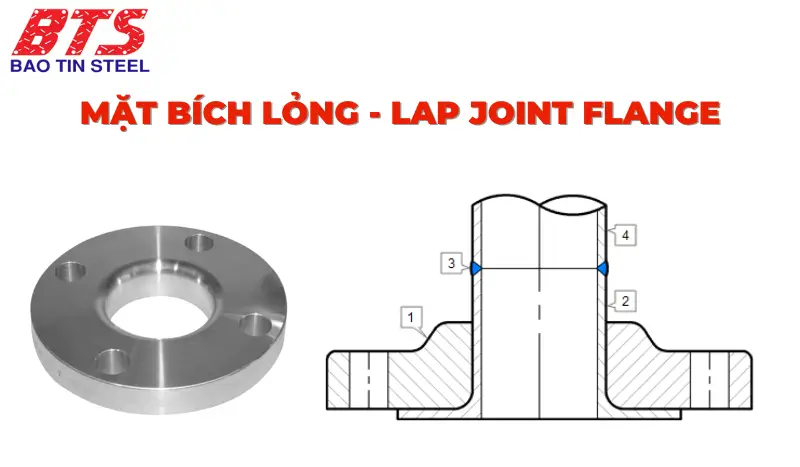
These flanges are nearly identical to Slip-on flanges, except for the radius at the intersection of the flange and the bore to accommodate the Stub End flange portion.
Their ability to hold pressure is quite low. Slightly better than the slip-on flange, and the fatigue life of the assembly is only 1/10 that of the weld neck flange.
They can be used at all pressures and are available in the full-size range. These types of flanges are not welded or attached to the pipe. The screw pressure is transmitted to the gasket by the pressure of the flange on the back of the flange liner (stud end).
Lap Joint flanges have some special advantages:
- Convenient in assembly because it is not welded directly onto the pipe.
- The possibility of corrosion is very low because it does not directly come into contact with the fluid inside the pipeline.
- Cheaper price
- High reusability
Detailed information about joint flanges
- Lap joint flange
- Stub End
- Weld
- Pipe or fittings
Stub End
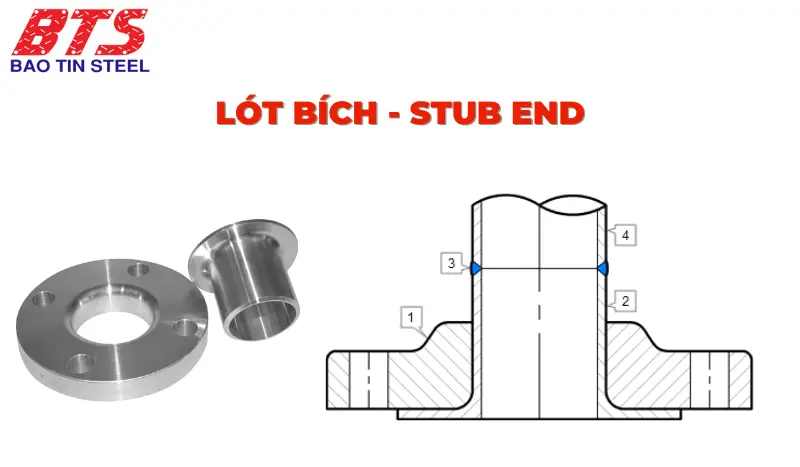
A Stub End will always be used with a Lap Joint flange, as a supporting flange.
These flange connections are applicable in low-pressure and non-critical applications and are an inexpensive flanging method.
For example, in a stainless steel pipe system, carbon steel flanges can be used because they do not come into contact with the fluid in the pipe.
Stub Ends are available in most pipe diameters. Dimensions and dimensional tolerances are defined in the ASME B.16.9 standard.
Stub Ends are lightweight corrosion resistant, this is defined in MSS SP43.
Below is a description of these two types of accessories.
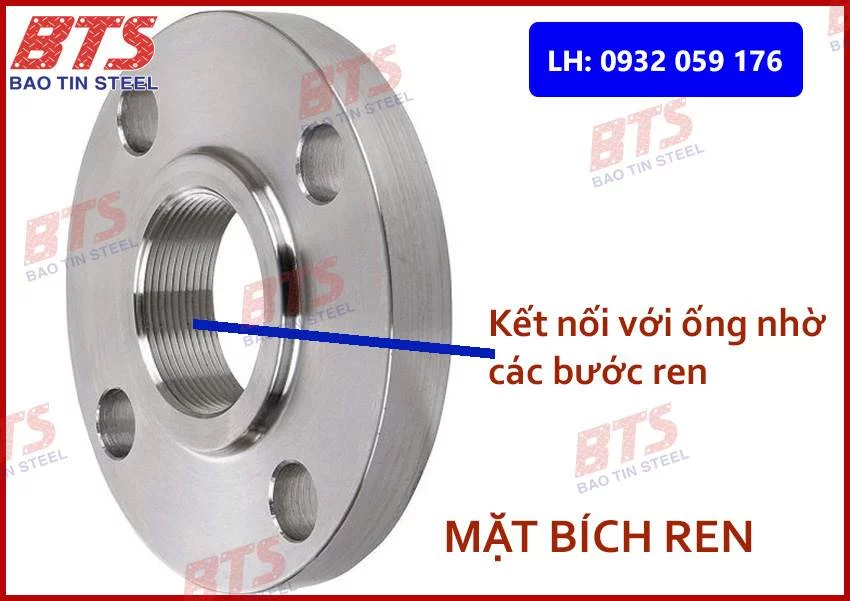
Threaded flange
Threaded flanges are used for special cases. The main advantage is that they can be attached to pipes without welding. Sometimes a sealed weld is also used in conjunction with a threaded connection.

While still available in most sizes and pressure ratings, threaded flanges are today used almost exclusively in small pipe sizes.
Steel flanges or threaded joints are not suitable for piping systems with thin wall thickness. Because these pipes cannot be threaded, threaded flanges can only be used on pipes with greater thickness.
To better understand these threaded connection regulations, readers can read more in the ASME B31.3 Piping Guide.
Where steel pipe is threaded and used for steam service above 250 psi or for water service above 100 psi with a water temperature above 220 °F. Piping shall use seamless steel pipe and be at least as thick as SCH80 of ASME B36.10.
Details of threaded flange:
- Threaded flange
- Threads
- Pipe or fittings
Blind flanges
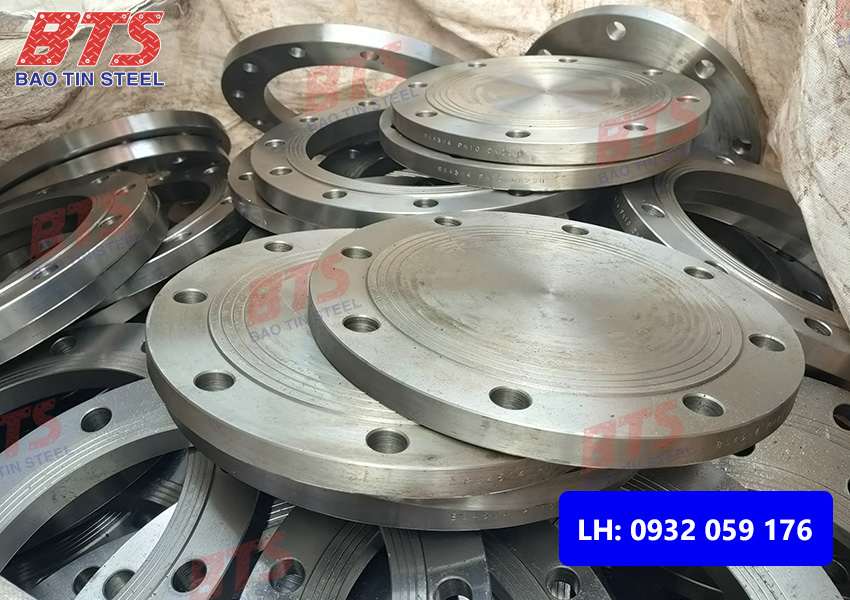
A blind flange is a type of flange used to close off the end of a pipe or an unused pipe connection in a pipeline system. It is designed with a flat flange and no round hole in the middle, so it is called “blind.”.

The blind flange is also one of the common types of flanges. It is used in cases where pipe connections are not required or need to be sealed to prevent the flow of liquid or gas. It is also used in cases where it is necessary to check the tightness of the pipeline system. It is also used for valves and pressure vessel openings.
From the standpoint of internal pressure and the construction of i-bolt centrifugal pile flanges, blind flanges, especially in larger sizes, are the most highly stressed of the above flange types. market.
However, most of these stresses are of the bending type near the center. And because there is no inside diameter, these flanges are suitable for higher-pressure temperature applications.
Blind flange connection details
- Blind flange
- Bolts and nuts
- Gasket / Flange gasket
- Other flanges
>> Each type of flange with a different structure also has a different price. If you are looking to buy flanges for your project, see the article “Prices of Flanges” to get the information you need.
Concrete Pile Flange
This type of flange is manufactured specifically for centrifugal piles used in construction. Normally, pre-stressed centrifugal piles are PC, PHC, A0, B300, C300, A, B350, C350, A0, B400, C400, A0, B500, C500, A600, B600, C600…. Accordingly, centrifugal pile flanges also have sizes in the range of D300 – D800. Below is a table of common centrifugal pile flange specifications. If you are interested in this type of flange, please see the table below:
| Flange type | Outside diameter | Inner diameter | Thickness (mm) | Number of holes | Cable (mm) | Coupling (mm) |
| A300 | 300 | 180 | 12 | 6 | 7.1 | 1.5 |
| B300 | 300 | 180 | 16 | 7 | 9.0 | 1.5 |
| C300 | 300 | 180 | 16 | 10 | 9.0 | 1.5 |
| A350 | 350 | 220 | 12 | 7 | 7.1 | 1.5 |
| B350 | 350 | 220 | 16 | 8 | 9.0 | 1.5 |
| C350 | 350 | 220 | 16 | 12 | 9.0 | 1.5 |
| A400 | 400 | 240 | 12 | 10 | 7.1 | 1.5 |
| B400 | 400 | 240 | 16 | 12 | 9.0 | 1.5 |
| C400 | 400 | 240 | 16 | 15 | 9.0 | 1.5 |
| A500 | 500 | 320 | 16 | 14 | 7.1 | 1.5 |
| B500 | 500 | 320 | 16 | 16 | 9.0 | 3.0 |
| C500 | 500 | 320 | 18 | 16 | 10.7 | 4.0 |
| A600 | 600 | 400 | 16 | 18 | 7.1 | 1.5 |
| B600 | 600 | 400 | 16 | 18 | 10.7 | 3.0 |
| C600 | 600 | 400 | 18 | 24 | 10.7 | 4.0 |

Conclude
Hopefully, after reading this article, readers will have a clear understanding of all types of flanges available on the market. If you need further advice on any type of flange or need to order a flange. Please enter your information in the form below. Experts from Bao Tin Steel will contact you as soon as possible!
Tiger Steel is a branch of Bao Tin Steel.