

 Tiếng Việt
 ភាសាខ្មែរ
Properly tightening flange bolts ensures safety and helps the efficiency of pipeline systems, machinery, and industrial equipment. If you tighten the bolts too small or too large, you may encounter risks such as leakage, damage, cracking, or breakage of the flange and bolts.
So what is the correct procedure for tightening flange bolts? In this article, Bao Tin Steel will introduce you to the necessary knowledge about the process of tightening flange bolts, helping you perform this job professionally and safely.
What is bolt tightening force?
Clamp load is the clamping force created by tightening bolts to hold components together in mechanical applications. This tightening force is created by applying torque to the bolt head with the help of tools like screwdrivers, bolt wrenches, hydraulic equipment, etc.

Factors affecting flange bolt tightening
The flange bolt tightening technique applies appropriate tightening force to the bolt to ensure a tight and safe connection to the flange. To have a correct and appropriate flange bolt tightening force, it depends on many factors: Material hardness, bolt diameter, bolt durability level, number of bolts, etc.
-> However, among the factors mentioned above, bolt diameter and bolt strength level are the two most important factors in determining bolt tightening force.
- The bolt’s durability level is usually printed on the top of the bolt’s face by the manufacturer and is evaluated by a number. For example, 8.8, 10.9, 12.9, etc. The higher the strength level, the stronger and more load-bearing the flange bolt.
- Bolt diameter will affect the bolt tightening force required to ensure a pressure seal. The larger the bolt diameter, the higher the required bolt tightening force will be.

Principles when tightening flange bolts
Working pressure, bolt hardness, bolt size, and number of bolts are factors that directly affect flange bolt tightening techniques. To always ensure accuracy when manipulating, you need to note:
Select suitable bolts and flanges.
Depending on each application, we will use different types of bolts and flanges. In particular, each type of bolt also needs to correspond to its own flange. When choosing the right bolts, the integrity of the flange will be guaranteed, avoiding cracks and breaks that cause leaks.
Check the cleanliness and lubrication of flanges and bolts.
Cleaning and lubricating bolts, flanges, and nuts is a basic but extremely necessary step in the flange bolt tightening process. This step helps the parts bond more firmly. At the same time, it eliminates corrosive factors that cause rust, affecting the longevity and operation of mechanical systems.
Use the appropriate bolt-tightening tool.
Depending on the size of the bolt as well as the strength of the flange, we will need a specific tightening force according to technical requirements. Therefore, choosing the right tightening tool helps ensure connection and safety for each steel structure. Accordingly, the process of tightening flange bolts is also more accurate, easier, and faster.
The bolt-tightening device will have parameters on maximum tightening force, recommended tightening force, and torque. To choose the right tightening tool, you need to understand the bolt-tightening torque standards. In Vietnam, documents you can refer to include:
Vietnamese standard TCVN 1916:1995
Requirements for bolt tightening force during installation according to standard TCVN 1916:1995 (reference)
| BOLT DIAMETER | DURABILITY LEVELS OF BOLTS TCVN 1916–1995 | ||||||||
|---|---|---|---|---|---|---|---|---|---|
| d | 4,6 | 4,8 | 5,6 | 5,8 | 6,6 | 6,8 | 8,8 | 10,9 | 12,9 |
| mm | N.m | N.m | N.m | N.m | N.m | N.m | N.m | N.m | N.m |
| M5 | 2,17 | 2,89 | 2,71 | 3,62 | 3,28 | 4,34 | 5.79 | 8,15 | 9,78 |
| M6 | 3,74 | 4,9 | 4,6 | 6,24 | 5,62 | 7,49 | 9.99 | 14 | 15,8 |
| M8 | 8,92 | 11,9 | 11,1 | 14,8 | 13,3 | 17,8 | 23.7 | 33,4 | 40,1 |
| M10 | 17,9 | 23,8 | 22,4 | 29,8 | 26,8 | 27 | 47.7 | 67,2 | 80,6 |
| M12 | 30,4 | 40,5 | 38 | 50,7 | 45,6 | 60,8 | 81.1 | 114,1 | 137 |
| M14 | 48,2 | 54,3 | 60,3 | 80,4 | 72,4 | 98,5 | 128.7 | 181,4 | 217,3 |
| M16 | 73,4 | 97,9 | 91,8 | 122,4 | 11,02 | 148,9 | 195.9 | 275,6 | 330,7 |
| M18 | 99,7 | 132,9 | 125 | 166,2 | 149,6 | 199,4 | 265.9 | 374 | 448,8 |
| M20 | 143,2 | 191 | 179 | 238,7 | 214,8 | 288,5 | 382 | 537,1 | 644,8 |
| M22 | 191,2 | 255 | 239 | 318,7 | 369 | 382,5 | 510 | 717,1 | 860,5 |
| M24 | 246 | 328 | 308 | 410 | 538,8 | 492 | 656 | 922,4 | 1107 |
| M27 | 359,2 | 479 | 449 | 598,7 | 675 | 718,5 | 958 | 1347,1 | 1616,6 |
| M30 | 450 | 600 | 563 | 750 | 990 | 900 | 1.2 | 1687,5 | 2.025 |
| M33 | 660 | 880 | 825 | 1.11 | 1.277 | 1.32 | 1.76 | 2.475 | 2.97 |
| M36 | 851,3 | 1.135 | 1.064 | 1.418,7 | – | 1.702,4 | 2.27 | 3.192,1 | 3830,5 |
| M39 | – | 1.614 | – | 1.997 | – | 2.279 | 3.139 | 4.463 | 5.223 |
| M42 | – | 1.995 | – | 2.464 | – | 2.816 | 3.872 | 5.515 | 6.453 |
| M45 | – | 2.497 | – | 3.085 | – | 3.525 | 4.847 | 6.903 | 8.079 |
| M48 | – | 3.013 | – | 3.722 | – | 4.254 | 5.849 | 8.33 | 9.748 |
| M52 | – | 3.882 | – | 4.795 | – | 5.48 | 7.535 | 10.731 | 12.558 |
| M56 | – | 4.839 | – | 5.978 | – | 6.89 | 9.394 | 13.379 | 15.656 |
| M60 | – | 6.013 | – | 7.428 | – | 8.49 | 1.1673 | 16.625 | 19.455 |
| M64 | – | 7.233 | – | 8.935 | – | 1.0212 | 1.4041 | 19.998 | 23.402 |
The table below is provided for reference purposes only. The use of the information and content below is the responsibility of the user and will be at their own risk. There are many variables that can affect the torque parameters and create errors.

Vietnamese Standard TCVN 8298:2009
Requirements for bolt tightening force during installation according to standard TCVN 8298:2009 (Reference)
| BOLT SIZE | BOLT TIGHTENING TORQUE, DANM FOR BOLT TYPE | |||||||||||
|---|---|---|---|---|---|---|---|---|---|---|---|---|
| mm | 3,6 | 4,6 | 4,8 | 5,6 | 5,8 | 6,6 | 6,8 | 6,9 | 8,8 | 10,9 | 12,9 | 14,9 |
| 1,6 | 0,005 | 0,006 | 0,009 | 0,008 | 0,011 | 0,010 | 0,013 | 0,015 | 0,018 | 0,029 | 0,030 | 0,035 |
| 2,0 | 0,011 | 0,013 | 0,018 | 0,016 | 0,022 | 0,020 | 0,027 | 0,030 | 0,036 | 0,050 | 0,060 | 0,070 |
| 2,5 | 0,021 | 0,025 | 0,033 | 0,031 | 0,042 | 0,038 | 0,050 | 0,057 | 0,067 | 0,095 | 0,114 | 0,133 |
| 3 | 0,038 | 0,046 | 0,061 | 0,058 | 0,077 | 0,069 | 0,092 | 0,104 | 0,123 | 0,174 | 0,208 | 0,243 |
| 4 | 0,093 | 0,112 | 0,150 | 0,140 | 0,187 | 0,168 | 0,225 | 0,253 | 0,300 | 0,421 | 0,506 | 0,590 |
| 5 | 0,181 | 0,217 | 0,289 | 0,271 | 0,362 | 0,326 | 0,434 | 0,489 | 0,579 | 0,815 | 0,978 | 1,140 |
| 6 | 0,312 | 0,374 | 0,490 | 0,460 | 0,624 | 0,562 | 0,749 | 0,843 | 0,999 | 1,400 | 1,580 | 1,960 |
| 8 | 0,743 | 0,892 | 1,190 | 1,110 | 1,480 | 1,330 | 1,780 | 2,000 | 2,370 | 3,340 | 4,010 | 4,680 |
| 9 | 1,12 | 1,35 | 1,80 | 1,68 | 2,25 | 2,02 | 2,70 | 3,03 | 3,60 | 5,06 | 6,07 | 7,08 |
| 10 | 1,49 | 1,79 | 2,38 | 2,24 | 2,98 | 2,68 | 3,58 | 4,03 | 4,77 | 6,72 | 8,06 | 9,41 |
| 12 | 2,53 | 3,04 | 4,05 | 3,80 | 5,07 | 4,56 | 6,08 | 6,85 | 8,11 | 11,41 | 13,70 | 15,98 |
| 14 | 4,02 | 4,82 | 5,43 | 6,03 | 8,04 | 7,24 | 9,85 | 10,86 | 12,87 | 18,11 | 21,73 | 25,35 |
| 16 | 6,12 | 7,34 | 9,79 | 9,18 | 12,24 | 11,02 | 14,89 | 16,53 | 19,59 | 27,56 | 33,07 | 38,58 |
| 18 | 8,31 | 9,97 | 13,29 | 12,46 | 16,62 | 14,96 | 19,94 | 22,44 | 26,59 | 37,40 | 44,88 | 52,36 |
| 20 | 11,90 | 14,32 | 19,10 | 17,90 | 23,87 | 21,48 | 28,85 | 32,23 | 38,20 | 53,71 | 64,48 | 75,20 |
| 22 | 15,90 | 19,12 | 25,50 | 23,90 | 31,87 | 28,68 | 38,25 | 43,03 | 51,00 | 71,71 | 86,05 | 100,40 |
| 24 | 20,50 | 24,60 | 32,80 | 30,74 | 41,00 | 36,90 | 49,20 | 55,34 | 65,60 | 92,24 | 110,70 | 129,14 |
| 27 | 29,90 | 35,92 | 47,90 | 44,90 | 59,87 | 53,88 | 71,85 | 80,83 | 95,80 | 134,71 | 161,66 | 188,60 |
| 30 | 37,50 | 45,00 | 60,00 | 56,25 | 75,00 | 67,50 | 90,00 | 101,25 | 120,0 | 168,75 | 202,50 | 236,25 |
| 33 | 55,00 | 66,00 | 88,00 | 82,50 | 110,0 | 99,00 | 132,00 | 148,50 | 176,0 | 247,50 | 297,00 | 346,50 |
| 36 | 70,93 | 85,13 | 113,50 | 106,40 | 141,87 | 127,68 | 170,24 | 191,52 | 227,0 | 319,21 | 383,05 | 446,90 |
Along with that, to know which type of bolt requires what tightening force and whether it will damage the flange, you also need to know how to calculate bolt size and how to look up the bolt tightening force table. Once you have these parameters, you will easily choose the appropriate flange bolt tightening machine or tool to best support your work.
Tighten the flange properly.
In addition to the bolt tightening force, the flange tightening technique is also very important. A flange is constructed with equal and evenly spaced holes. For each type of flange, these boreholes also have different sizes and arrangements to suit different systems.
Accordingly, in order for the surface of the flange to be preserved and the machine structure to be durable, the tightening force needs to be evenly distributed when tightening. Specifically, when tightening flange bolts, you need to tighten reciprocally and in series to maintain balance and correct technique.
Check after completing work
After you have properly and thoroughly tightened the flange bolts, you need to check the tightening joints to make sure the bolts are not loose, misaligned, or slipped out.
You need to remember that each application will require a different flange bolt tightening technique. If you are not really sure about your skills and workmanship, you should carefully refer to the instructions from the manufacturer to minimize possible errors.
Instructions for properly tightening flange bolts
As mentioned, depending on the application and bolt strength, the flange bolt tightening process is also different. To make it easier for you to imagine, Bao Tin Steel will provide instructions for tightening flange bolts with two types of low-pressure.
Tighten the low-pressure flange bolts.
Tighten by hand
With the low-pressure flange, you can easily tighten it by hand. This procedure applies to 8-bolt flanges, including:
- Step 1: You proceed to tighten symmetrically perpendicular to each other once. At this time, use a closed wrench or a curved handle to tighten and tighten in order from 1 to 8 (as shown).
- Step 2: When tightening bolt number 8, you tighten 1 turn starting from 8 with the correct tightening force as required. The order for tightening this flange bolt is: 1→2→3→4→5→6→7→8→4→6→2→7→3→5→1→8
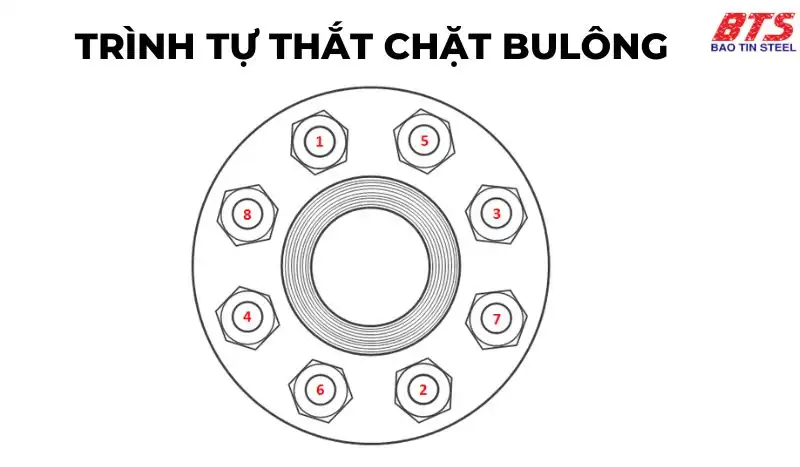
*Note:
- When tightening low-pressure flange bolts by hand, only one person must do so to ensure the tightening force is evenly distributed.
- Use a caliper or ruler to check the gap at the four flange corners. If the gap at these four corners is not equal, you need to tighten it symmetrically to the place with the largest gap.
- Do the same with 12, 16, and 24-hole flanges.
Tighten with a hydraulic wrench.
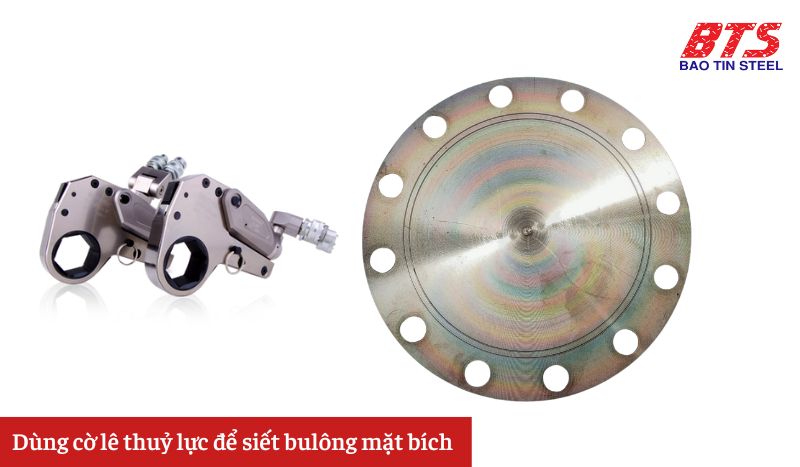
With the same steps as above, you can also tighten the low-pressure flange bolts with a hydraulic wrench. However, with this tightening method, you need to perform three symmetrical tightening times with three levels of force according to the regulations and requirements. Specifically:
- Step 1: Similar to when tightening flange bolts by hand, you tighten in order from 1 to 8 with force level 1.
- Step 2: Do the same as in Step 1. You also tighten the flange bolts from 1 to 8 with force level 2. Then, increase to force level 3 to proceed with tightening a third time.
-
Step 3: Using force level 3, tighten the bolts evenly. At this point, the bolts have been tightened securely.The process of tightening low-pressure flange bolts with a hydraulic wrench is as follows:
1->2->3->4->5->6->7->8->1->2->3->4->5->6->7->8->1->2->3->4->5->6->7->8->4->6->2->7->3->5->1->8
Tighten high-pressure flange bolts.
The process of tightening high-pressure bolts cannot be done by hand but must use tools such as hydraulic wrenches and bolt tensioners.
Once you have chosen the appropriate tightening tool, you just need to proceed, as when tightening low-pressure flange bolts that Bao Tin Steel just shared, it’s really simple, isn’t it?
Why is it necessary to follow the instructions for tightening flange bolts correctly?
As mentioned at the beginning of the article, tightening flange bolts incorrectly or not following the principles will cause unpredictable consequences. Specifically:
In case the flange bolt tightening force is not enough
This is one of the technical errors that often happen to mechanics who do not have much experience or expertise. This mistake can cause the bolt to become loose and slip out of the flange, causing the structure to be misaligned and causing problems when the machine operates.
In case the flange bolt tightening force is too large
In contrast to insufficient bolt tightening force, when this tightening force is too large, it also causes significant problems. These include cracked or broken flanges, broken bolts, etc., thereby causing other parts to be affected.
It can be seen that following the instructions for tightening flange bolts is extremely necessary. Hopefully, the information that Bao Tin Steel has just provided will help you better understand the tightening process as well as perform the correct technical operations. If you have any issues that need assistance, don’t hesitate to contact us immediately!