

 Tiếng Việt
 ភាសាខ្មែរ
In industrial pipeline systems, overpressure is extremely dangerous. If the pressure is too great, it will cause a rupture and damage to equipment in the pipeline. To increase system safety, we use safety valves. So what is a safety valve? In this article, Bao Tin Steel will answer and introduce safety valves more clearly.
What is a safety valve?
Many people wonder what a safety valve is.ì
The safety valve is a hydraulic device used to regulate pressure in pipes, gas, or liquid tanks. The main task of the safety valve is to protect the hydraulic circuit from pressure increases exceeding the rated value. This type of valve belongs to the group of devices that regulate input pressure.
During work, the safety valve is always in a closed state. When the valve’s inlet pressure exceeds the rated value (pre-set rated value), the safety valve opens, allowing part of the liquid or gas inside the pipeline to be released into the environment or possibly discharged to the tank.
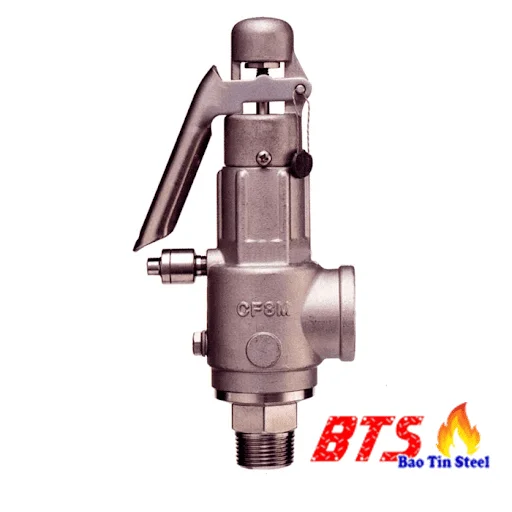
In short, the valve is initially installed or set to a default pressure level (depending on the job and requirements, this setting number may change). If the pressure exceeds that number, the safety valve will operate to relieve pressure so that the pressure does not exceed the set threshold.
You can refer to some commonly used industrial valves on the market today:
Why should you use safety valves?
As mentioned above, safety valves protect pipes from sudden pressure increases. If there is no safety valve, the system will easily encounter: broken pipes, damage, or even danger to humans, as well as the surrounding environment.
What is the rated pressure of the safety valve?
The rated pressure of a safety valve is the pressure set to ensure safety for pipes and equipment in the system.
- The direct safety valve has only one rated pressure.
- The indirect safety valve has a main valve-rated pressure and a secondary valve-rated pressure. The auxiliary valve-rated pressure can be adjusted to the rated pressure with the adjustment knob; however, the adjustment must always be less than the main valve-rated pressure.

Classification of safety valves
On the market today, there are many types of safety valves with different sizes, designs, manufacturers, etc. However, they can be divided into two types: direct-acting safety valves and indirect-acting safety valves.
Direct-acting safety valve
The direct safety valve is a type of valve that will operate the discharge function directly thanks to the pressure of the valve disc acting on the spring. They are often applied to systems with an average pressure that is not too high.
– Structure:
Direct safety valves are composed of the following basic parts: valve body, rotating part to discharge fluid out, part connecting to the pipe, disc, spring, spring cushion, protective cap, valve disc shaft, stopper, adjusting screw, and pull handle.
– Operating principle:
Direct safety valves operate on the principle of force balance between opposing forces (spring or piston elastic force and fluid pressure) acting on the valve disc or piston.
- When the inlet pressure is less than the valve’s rated discharge pressure, the piston is in the closed position.
- When the inlet pressure is greater than the rated discharge pressure, the piston moves, and the valve will begin to open. From there, the fluid is discharged through the valve until the inlet pressure returns to the rated discharge pressure level.

– Advantage:
- Has a simple structure.
- Fast response speed, helping the valve promptly reduce (adjust) pressure.
– Disadvantages:
Besides the advantages mentioned above, the valve still has disadvantages: Easily limited by spring size.
=> If the pressure rises too high (or too low), the valve size may not be sufficient to accommodate the spring tension. This affects the function, and if chemical environments are used, the springs will also corrode, reducing their expected effectiveness.
Indirect-acting safety valve
Indirect-acting safety valves are often used in high-pressure hydraulic systems where direct-acting safety valves cannot be applied. Therefore, the design of an indirect safety valve will be more complicated than a direct-acting safety valve.
– Structure:
- The main valve has a large-diameter piston and a spring with small stiffness.
- The auxiliary valve has a small-diameter piston and a high-stiffness spring.
=> These two main and auxiliary valves have the function of increasing their ability to respond to high-pressure environments.
– Operating principle:
Indirect safety valves operate on the principle of force balance of opposite forces (spring or piston elastic force and fluid pressure in the main valve cavity set by the auxiliary valve) acting on the valve disc. or piston.
-> In the normal state, the inlet pressure is less than the rated pressure. Both the auxiliary valve and the main valve are closed.
- When the inlet pressure increases above the auxiliary valve-rated pressure. The auxiliary valve disc (or piston) will open to allow fluid to flow through the auxiliary valve. In this case, the fluid pressure is greater than the auxiliary valve pressure but still smaller than the main valve pressure.
- When the input pressure increases above the main valve’s rated pressure and overcomes the spring’s elastic force, the main valve will open to allow fluid to flow through the main valve to the tank.

– Advantage:
When talking about the advantages of indirect safety valves, we must mention the compact valve design and high tightness. Suitable in environments with high pressure and temperature. At the same time, they can also adjust pressure ratings to many values.
– Disadvantages:
The reaction speed of an indirect-acting safety valve will be slower than that of a direct-acting safety valve. Not only that, the price of this type of valve is also higher than other types of valves.
Application of a safety valve
As mentioned above, the safety valve has the function of protecting the system. With important tasks, safety valves are commonly used in many fields, specifically:
- Used in steam drum and boiler systems
- Chemical and petrochemical systems
- Application in warmers
- Food processing system
- Used in high-speed burner systems,…
Things to keep in mind when using safety valves
A safety valve is a device responsible for protecting the system, but if used incorrectly, it can endanger both the system and human life. Therefore, to ensure safety when using the safety valve, you should note the following:

Safety size
The size of the safety valve is one of the most important things. A suitable valve that operates effectively is one whose size meets the system capacity and pipeline flow.
- If the safety valve is smaller than the discharge capacity, it will slow down the pressure reduction process, increasing the risk of rupture and explosion.
- If the safety valve is too large, it may not be possible to open the valve. Excess pressure causes the Safety Valve to close, making the valve’s working cycle ineffective.
Install it in a safe location.
- Safety valves do not have to be installed in any position. The safety valve is only suitable for installation in the upper positions, the hood, and vertical places with springs.
- Between the safety valve and the system, you do not install any type of valve.
- Do not install the valve upside-down.
- Do not install bent or folded pipes between the safety valve and the system.
Valve conditions operate effectively.
For the safety valve to work well, the following conditions must be met:
- When setting the pressure, the pressure balance (opening) should be established, and the pressure should start to open.
- The accumulation is the pressure rising above the system’s maximum working pressure during operation, discharged through the safety valve.
- Pressure too high, back pressure, etc.
Address providing genuine and reputable safety valves

To solve that problem for customers, Bao Tin Steel Company Limited can fully meet and resolve all those doubts. All products in general, and safety valves in particular, are imported directly from the manufacturer.
In particular, before being put into Bao Tin Steel’s warehouse, products must pass a strict selection and inspection process. Fully guarantee the quality, design, and labeling of each product. The commitment is that all types of safety valves provided by Bao Tin Steel are genuine and score 10 for quality.
So we have learned together what a safety valve is? as well as basic knowledge about safety valves. Depending on the needs and purposes of use, this device may be different. If you have any questions or want to purchase, please contact Bao Tin Steel for advice and an accurate quote.