

 Tiếng Việt
 ភាសាខ្មែរ
How do I properly weld a flange? What should we pay attention to when welding flanges? This process requires everyone to grasp the basic knowledge of effective welding methods. Therefore, in this article, Bao Tin Steel will provide detailed instructions on how to weld flanges and notes when welding to ensure technique and safety. Let’s find out the content below.
How to weld flanges properly
Suppose you want to weld a flange properly and use the right technique. In that case, you must first adjust it so that the flange is always perpendicular to the pipe, valve, or equipment to limit deviations while assembling the piping system.
Align the flange perpendicular to the steel pipe.
- First, you need to place the steel pipe on a flat surface and use a level to measure the pipe’s balance. If the level is not balanced, place a wooden board under the pipe (so that the pipe is balanced). If the pipe is not balanced, the flange welding will be misaligned, and when the two flanges are tightened together, the seal will be exposed.

- Do not place the flange close to the outside edge of the steel pipe. If you put the flange too close to the pipe, the weld will protrude; if you grind it too carefully, the weld will be thin and weak. If the weld protrudes without grinding, the next step will be difficult to perform.
-> It is best to place the edge of the connecting pipe in the middle of the pipe of the flange.
- Use a magnetic angle ruler to align the angle between the flange and the connecting pipe.
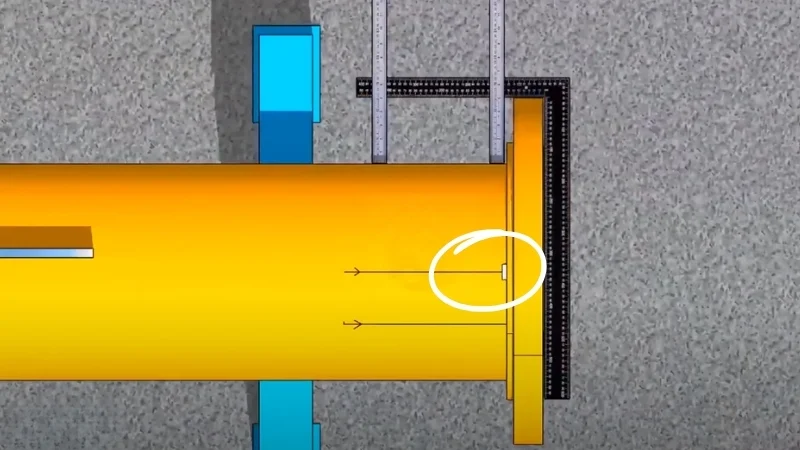
- Normally, the flange will be about 1-2mm wider than the pipe, so you will need to do the wedge step to prevent the flange from sagging. Note that the shim materials must be thin and uniform, especially the shim, so that the connecting pipe must be in the middle of the flange. Finally, use a level measure to balance again.

Instructions on how to properly weld flanges
Step 1: Dot solder to fix between points, about 4 points (top, bottom, and 2 sides). To ensure balance between the flange and the connecting pipe, after welding, each dot will continue to be aligned with a level.

Step 2: Weld the outside first; weld the inside later.
When welding inside pipe openings and flanges, you should NOT make welds that are too big or too thick. Because it takes a lot of effort to grind it smoothly, if you don’t grind it carefully, it will be very difficult to put the grout in.
External welds can be welded in 2 layers to ensure stability.
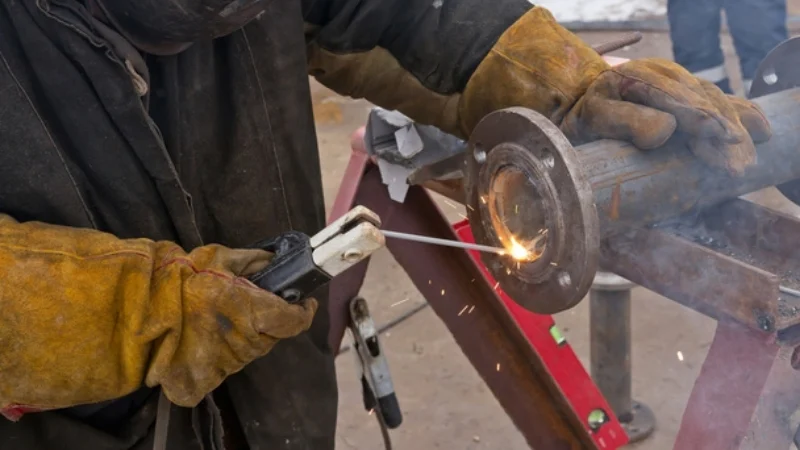
Step 3: Check and complete
After grinding and polishing the welds to ensure aesthetics, Please check again and complete the process of welding the flange to the pipe.
=> At this point, you must have grasped the correct technique for welding flanges, right? If you are wondering how to connect or install flanges, you can refer to Bao Tin Steel’s article How to Install flanges.
The most common flange welding methods today

TIG welding machine
The TIG welding method is an arc welding technique with a non-melting electrode in an inert gas environment. The inert gas environment protects the arc area from the harmful effects of oxygen and nitrogen in the air. The non-melting electrode (Tungsten) often used is Tungsten, so this type of welding is called TIG (Tungsten Inert Gas) welding or Argon welding.
| Advantage | Disadvantages |
| High-quality solder primer: aesthetic, less block, less welding slag | Equipment and processes are complex, requiring highly skilled welders. |
| Can weld most metals, including non-ferrous metals | Not effective for mass production |
If the application requires welding with low or thin thickness, you should use a TIG welding machine. Because it only needs to be welded once on each side of the joint and can be machined smooth or finished with filler metal.
MIG welding machine
MIG welding (MAG) is a welding method belonging to the GMAW method group that uses a continuously supplied welding wire and shielding gas (inert gas or active gas) to protect the welding area from air pollution. In the MAG welding industry with CO2 protective gas, it is often called wire welding or CO2 welding.
| Advantage | Disadvantages |
| The quality of the weld is high: The weld has little impurities, is beautiful, and even | High cost |
| Fast welding speed | Requires good welding conditions |
If the application has a high thickness, a MIG welder is a better choice. Because they will penetrate deeper into the material while still ensuring quality, not being damaged, and not overheating.
Besides the above two methods, you can also weld the flange using an electronic rod or a mechanical welding machine. However, the welding speed is not as high, and the working efficiency is not as high as in MIG and TIG welding machines.

Note when welding flanges
- Ensure labor safety. Always follow labor safety principles when welding, and use full tools and protective equipment.
- Weld in a well-ventilated environment. Avoid welding in closed environments, with toxic gases, etc.
- Depending on the thickness of the welding material, choose the appropriate welding method.
- The step of aligning the flange perpendicular to the connecting pipe is very important. It is necessary to follow the instructions above so that the next steps such as connecting grout and joining the two flanges together will be easier.
- Check weld quality. After welding, it is necessary to check the quality of the weld to ensure the safety of the project.
Above are the issues related to flange welding that Bao Tin Steel shared. Flange welding is widely used in the mechanical industry, etc. Mastering welding knowledge will help workers perform the correct technique, evaluate whether the quality of the weld meets the requirements or not, and thereby have a basis to improve their welding skills and techniques.
Tiger Steel is a branch of Bao Tin Steel.