

 Tiếng Việt
 ភាសាខ្មែរ
Distinguishing between hot-rolled and cold-rolled steel is a question many customers ask about Bao Tin Steel.
When you start your project, it’s time to know what type of steel will best suit your project’s needs.
Different steelmaking methods can produce better working materials for specific applications.
Especially the two methods of producing hot-rolled and cold-rolled steel. They especially have a great influence on the overall performance of finished steel.
Being knowledgeable about the differences between the two methods can help your company save time, material costs, and additional processing.
This article by Bao Tin Steel aims to explain the difference between hot-rolled steel and cold-rolled steel. Includes discussion of the advantages and limitations of each method.
Learn about hot-rolled steel and cold-rolled steel.
What is hot rolled steel coil?
Hot-rolled steel is a type of steel produced by rolling at very high temperatures, often above 1000°F. This gives the steel better formability and machinability than untreated steel, making the processing in the next steps easier.
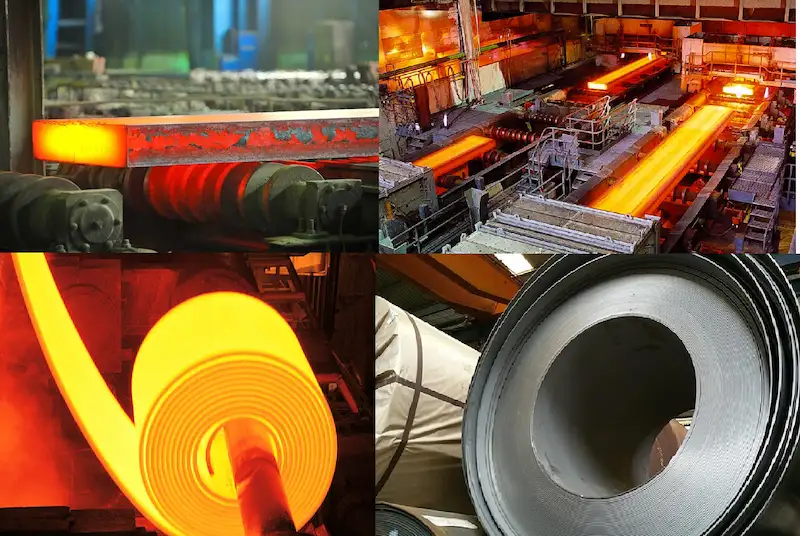
This process goes as follows:
- Billets from the steel mill will be put into furnaces to be heated. The temperature of steel in conventional heating furnaces is above 1000 °C (recrystallization temperature of steel).
- After that, the steel billets are continuously rolled until formed.
Advantages and disadvantages of cold-rolled steel
– Advantage
- The hot rolling method reduces the yield stress of steel while increasing its ductility. It makes it more malleable and can be precisely shaped.
- When steel is continuously heated and rolled, the particles in the steel diffuse better. It helps eliminate or reduce the heterogeneity of finished steel products.
- The hot rolling process of steel also helps reduce the size or completely close the pores formed by oxygen escaping from the steel surface.
– Disadvantages
- Steels, after being hot-rolled, are usually cooled to room temperature. This cooling process often takes place unevenly. Leading to the formation of many residual stresses in finished steel products. Especially in steel types with uneven cross-sections, such as rails, I-beams, etc.
- The overall dimensional tolerance of finished steel usually falls between 2 and 5%.
- Although the finished products are of good quality, their surface is often covered with an oxide film (which can be called rolling scales—scales formed after hot rolling). This is an oxide that forms at high temperatures. The finished product’s aesthetics are not high, but they can be overcome with several techniques: bleaching, grinding, or sandblasting.
What does a hot rolled steel coil do?
These properties make hot-rolled steel best suited for structural components and other applications that do not require extreme shapes and tolerances, such as:
- Railway steel
- Hot-rolled steel plate
- I-beam
- Truck frame
- Car clutches, wheels, and wheel rims
- Casings of compressors, etc.
Cold-rolled steel
Cold-rolled steel (CFS) is a general term referring to steel products produced by cold working processes (processing at room temperature).
Cold-rolled steel is a type of steel that is rolled at a lower temperature than hot-rolled steel, usually around 700 to 900 degrees Celsius. After being rolled, cold-rolled steel is further processed by processes. such as shearing, cutting, bending, or flattening, creating steel products with high strength and good dimensional accuracy.
Common cold processing methods are: rolling, pressing, stamping, bending,…
You will be interested in:

Advantages and disadvantages of cold-rolled steel
– Advantage:
The strength and hardness of finished steel are high, usually 15–20% higher than those of hot-rolled steel. This result is achieved by the bending or machining processes of steel.
- The yield stress value of cold-formed steel usually ranges from 33 ksi to 80 ksi.
- The elastic modulus of cold rolled steel can reach from 29,000 to 30,000 ksi.
Cold-rolled steel allows for the creation of highly precise steel products. Since the entire machining process is performed at room temperature, the steel will not contract as it does in the hot rolling process.
Cold-rolled steel has a highly aesthetic and smooth surface because it does not form an oxide film.
The quality of the finished product is consistent.
– Disadvantages:
The load-carrying capacity of cold-rolled steel bending and compression members is often limited by the yield point. The bending stress is less than the yield point of the steel, especially for compression members with a relatively large flat width ratio and for compression members with a relatively large slenderness coefficient.
The shape of the finished product is often limited to certain shapes: square, round, oval, rectangular, etc. Because at this time the steel has cooled, the hardness and durability increase while the ductility decreases. It makes cold-rolled steel more difficult to shape.
What does cold-rolled steel do?
- Manufacture of household appliances
- Furniture production
- Components require high precision,…
It has good hardness and toughness, can withstand large loads, and is easy to cut, weld, and cut. Because of these characteristics, cold-rolled steel is often used in products that require high quality and good load-bearing capacity.
What is the rolling process?
Rolling is a process in which the material is drawn by friction between two rotating cylindrical rollers that reduce the thickness of the material.
- During this process, two cylindrical rollers attached to bearings are driven with the help of a powerful motor.
- The tolerance between rolls can be effectively calibrated according to needs.
- This distance, or tolerance, is called the roll distance of the calibrated hole.
- It is one of the most efficient and reliable metalworking processes that helps achieve high output.
- During this process, strict control of the final product is also relatively easy.
Hot rolling process
Hot rolling is a metalworking process that occurs at temperatures exceeding the recrystallization temperature of the material. After the grains are deformed during machining, they recrystallize, maintaining a uniform microstructure and preventing the metal from hardening. The starting material is usually semi-finished casting products such as casting bars, casting plates, casting joints, and round bars.
The cold rolling process
Cold rolling occurs when the metal is below its recrystallization temperature (usually at room temperature), increasing its hardness through a mechanical process by up to 20%. It also improves the surface and holds tight to dimensional tolerances. Commonly cold-rolled products include plates, strips, bars, and rods. These products are typically smaller than their hot-rolled counterparts. Due to the smaller size of the products and higher hardness compared to hot-rolled stock, four-roll or cluster mills are used. Cold rolling cannot reduce the thickness of a product like hot rolling in one pass.
See more detailed explanation at wikipedia.
Terminology in metal rolling
Before going into the detailed process, we will learn some terms used in the rolling process.

Ingot
- It is a cast metal and has a very high temperature of about 1200 degrees Celsius.
- It is completely porous and vented.
- The size of the blank depends on the project requirements, and it can be of different sizes.
Blooms
- Bloom is the first material made from billets.
- This is the first material produced from billets.
- It is produced at very high temperatures.
- It can be square or rectangular, and the dimensions can be 150mm x 150mm, 150mm x 200mm, or 250mm x 250mm.
Billets
- Billets are produced from billets.
- Workpiece size is about 50mm x 50mm, 100mm x 100mm, or 125mm x 125mm.
- Manufactured as: pipes, wires, bars, etc.
Slab
- Panels are made from billets.
- It can be rectangular in shape, and the size will range from 600mm to 1500mm in width and 50mm to 160mm in thickness.
Plate
- The sheet is further rolled to form a sheet.
- It can be finished or semi-finished.
- The thickness of the plate is more than 6 mm.
Sheet
- This is formed from slabs.
- Very thin, and the maximum thickness is about 6 mm.
Strip
- It is manufactured from a sheet.
- The maximum width is 600mm.
- The maximum thickness is 6 mm.
Foil
- The strip is very thin.
- The maximum width is 300 mm.
- Maximum thickness: 1.5mm.
Bar
- A long and straight piece of metal.
- Uniform cross-section.
- It can be circular, i.e., a bar, or it can be square.
Wire
- It is formed from bars.
- Very thin.
- Dimensions are 9.5 mm square in cross-section.
Rolling process
- In this case, the workpiece or material undergoes plastic deformation due to compressive force.
- The length is lengthened and the cross-sectional area is reduced, but the total volume remains the same.
- The shafts compress the material or workpiece by creating compressive stress due to rotational action.
- The initial material processing, i.e., the billet, is produced using a metal mold.
- Ingots can be of any geometric shape and size.
- It is obtained by obtaining molten metal in a furnace.
- At the appropriate temperature, the molten metal is poured into the metal mold cavity and allowed to cool.
- After this process, solid metal is removed, and this metal is called ingot.
This ingot is now passed through rolls to get the desired shape as per need, such as:
- billets,
- bars,
- slabs,
- plates,
- sheets
=> Learn more about the “rolling” processing method.”
Describe the hot-rolled and cold-rolled steel production processes.

Stage 1: Ore Processing
- During this stage, input materials such as pellets, iron ore, sintered ore, and additives such as coke and limestone are fed into the furnace. Blast furnace.
- If it is scrap, it will also be heated to a certain temperature to create a stream of molten metal (hot metal).
Stage 2: Create molten steel flow
- The molten metal flow formed from stage 1 is directed to the basic oxygen furnace, or electric arc furnace.
- Here, hot metal is processed, separating impurities and creating correlations between chemical components.
- It is the basis for deciding which batch of steel is created for which type of product and which steel grade.
- For example, the steel batch will be used to roll SD390 rebar steel, and the chemical components will be adjusted right at this stage to produce SD390 steel grade.
Stage 3: Casting supplies
The metal flow after leaving stage 2 is sent to:
- Steel Castings: Casting other products.
- Go to the embryo casting furnace. From this furnace, three types of embryos will be cast:
The billet is a type of bar billet with cross-sections of 100×100, 125×125, and 150×150 and a length of 6-9-12m. They are often used to roll construction steel coils and rebar steel.
Slab billet (Slab) is a type of billet often used to roll out hot-rolled steel coils, hot-rolled steel plates, cold-rolled steel plates, or shaped steel.
Bloom blanks are a type of blank that can be used as a substitute for bar blanks and slab blanks.
After the casting is completed, it can be left in two states: the hot state and the cooled state.
Hot direct rolling state: This state maintains the billet at a high temperature after leaving the billet forming process to bring it straight into the product rolling process.
The cold state of the billet is transferred to other factories and will be reheated (reheating furnace) at those factories to be included in the product rolling process.
Stage 4: Rolling
Billets are brought into factories to roll out steel products.:
- Bring the billet into the section mill to roll out the following steel products: Rail (steel rail); Sheet Pile (steel sheet pile); Shape (shaped steel of all kinds); and Bar (construction steel bar).
- Bring the billet to the steel mill (wire rod mill) to roll out plain-rolled steel for construction.
- Bring the billets to the plate mill to roll out cast steel plates.
- Bring the billet into the hot rolling steel mill (hot strip mill); the billet will be rolled into the hot rolling steel coil (hot roll coil-HRC).
Or cut steel sheets (immediately cut into rolls and bales—Baotou Goods).
During the process of rolling out hot-rolled steel, the rolled steel is at a high temperature (780°C).
If you want to roll out cold-rolled steel (cold roll coil-CRC), lower the temperature of that steel roll to the appropriate temperature (480°C) and continue rolling to reduce the thickness.
Thus, right at this stage, cold-rolled steel coils and hot-rolled steel coils are produced.
Currently, re-rolling factories in Vietnam are using hot-rolled steel billets (1.75–5.0 mm) and then putting them in the furnace to the appropriate temperature (480°C) to reduce them. the thickness of cold-rolled steel.
For example:
–From hot rolling steel mills, after rolling out hot rolled steel coils, they can be taken directly to the welded pipe mill.
Bring billets into the seamless pipe rolling mill to produce cast steel pipes.
Above is the manufacturing process for steel products.
So we can understand how cold-rolled and hot-rolled steel are produced.
Is construction steel hot-rolled or cold-rolled?
Construction steel is usually produced from hot-rolled steel. The process of producing hot-rolled steel involves passing the steel through a hot furnace to melt and then feeding it into a rolling mill to create thick and wide steel plates. Accordingly, hot-rolled steel often has higher ductility and durability than cold-rolled steel.
However, in some special cases, cold-rolled steel can also be used in construction, especially when precise mechanical properties and dimensions are needed for specific applications. like windows and doors. Cold-rolled steel is produced by passing steel plates through rolling mills that have lower temperatures than the hot-rolled steel production process.
In summary, in the majority of construction applications, hot-rolled steel is the most commonly used material for construction projects, but in some special cases, cold-rolled steel can also be used.
What is the difference between hot-rolled steel and cold-rolled steel?
As pointed out above, the main difference between hot-rolled steel and cold-rolled steel is the temperature at which they are processed. Hot-rolled steel is rolled above the recrystallization temperature of the material, while cold-rolled steel is rolled below the recrystallization temperature of the material. In addition to this quality, there are a few other differences between the two materials, including regarding the following:
- Surface quality. Hot-rolled steel tends to have rough edges and surfaces that require decarburization or other treatments to prepare it for use in subsequent manufacturing operations. In contrast, cold-rolled steel typically has a shiny and smooth surface that allows it to be used as-is in manufacturing operations.
- Material hardness. The cold rolling process produces steel with much higher strength and hardness than steel produced by the hot rolling process.
- Internal tension. The greater material strength and stiffness introduced by the cold rolling process are accompanied by greater internal stress. These stresses must be removed before the material can be processed; otherwise, the part or final product may become warped.
These two types of steel should not be confused with the technical specifications or grades used to classify steel by composition or physical characteristics. Steel can be hot-rolled or cold-rolled, regardless of its specifications or metallurgical grade.
Comparison table of cold-rolled steel and hot-rolled steel
| Cold-rolled steel | Hot rolled steel coil | |
| Regular thickness | 0.15mm-2mm | 0.9mm or more |
| Surface | Bright white, high gloss. | Characteristic dark, dark green |
| Border edge | Usually trimmed with straight edges and sharp edges | The two edges of the roll are often rounded and rough, and they turn rusty when left for a long time. |
| Preserve | Cold-rolled goods are often packaged and kept indoors. The surface quickly rusts and becomes unusable. | Hot-rolled steel coils can be left outdoors for a long time and do not require packaging. |
Conclude
The main difference between hot-rolled and cold-rolled steel is in how they are processed. Hot-rolled steel is steel that has been rolled at high temperatures, while cold-rolled steel is essentially hot-rolled steel that has been further processed in a cold-reducing material. Here, the material is cooled, then annealed and/or hot-rolled. Steel comes in different grades and specifications that can be hot-rolled or cold-rolled. Understanding the difference between hot-rolled steel and cold-rolled steel can help you determine the best type for your needs.
Hopefully, with the analysis and comparison table of hot-rolled steel and cold-rolled steel above, readers will no longer be confused between hot-rolled and cold-rolled steel. Thank you for reading the article. See you again in the following steel knowledge articles.