

 Tiếng Việt
 ភាសាខ្មែរ
Electrolytic galvanizing and hot-dip galvanizing are two popular methods widely used in construction. Each method has its advantages and disadvantages, so choosing the right product to maximize the benefits is something everyone is interested in. Understanding customer psychology, Bao Tin Steel will share necessary and detailed information about hot-dip galvanized steel pipe in this article. We invite you to consult!
After reading this article, you will get the answer to the question: What is a galvanized steel pipe? Advantages and disadvantages, production process, and famous brands producing hot-dip galvanized pipes today.
Learn briefly about hot-dip galvanized steel pipes.
What is a hot-dip galvanized steel pipe?
Hot-dip galvanizing is a method of coating a layer of zinc on the surface of steel pipes to prevent corrosion. The zinc is melted at a high temperature, then the steel pipe is dipped into this liquid. This process protects the steel from environmental corrosion.
Hot-dip galvanized steel pipe is a black steel pipe product that cleans the outer and inner surfaces of the pipe. The next step will be dipping the pipe into a hot-dip galvanizing bath. Depending on the wall thickness of the material, the dipping time and zinc coating will vary. That’s why people call them hot-dip galvanized pipes, and this product is completely different from galvanized steel pipes.
A galvanized steel pipe, also known as a galvanized pipe, is a product rolled from available galvanized raw materials (meaning the raw material billet is galvanized), and then, through the production process, it will be rolled onto steel raw materials. Finished galvanized pipes.

Hot-dip galvanized pipe specifications
- Steel pipes are manufactured according to standards ASTM A53, BS 1387, BS EN10255, AS 1074,….
- The quality control process complies with ISO 9001:2015 standards to ensure that all project requirements are met.
- Steel grades that can be used: SS400, SAE, SPHC,… according to ASTM A500, A53 standards
- Origin: Vietnam, imported from other countries
- Specifications: phi 21 – phi 219 (DN15 – DN200)
- Thickness: 1.6mm – 6.35mm

To help customers better understand this type of steel pipe, Bao Tin Steel shares the technical specifications table below:
| SPECIFICATION TABLE OF HOT DIP-GALVANIZED STEEL PIPES ACCORDING TO ASTM STANDARDS A53/ A106/ A312/ API 5L/ ASME | |||||||||||||
|---|---|---|---|---|---|---|---|---|---|---|---|---|---|
| WEIGHT (kg/length) |
OUTSIDE DIAMETER (mm) |
||||||||||||
| 21,2 | 26,65 | 33,5 | 42,2 | 48,1 | 59,9 | 75,6 | 88,3 | 113,5 | 141,3 | 168,3 | 219,1 | ||
| PIECES/BUNDLE | 168 | 113 | 80 | 61 | 52 | 37 | 27 | 24 | 16 | 16 | 10 | 7 | |
| THICKNESS (mm) |
1,6 | 4,64 | 5,93 | 7,56 | 9,62 | 11 | – | – | – | – | – | – | – |
| 1,7 | 4,91 | 6,28 | 8 | 10,19 | 11,68 | – | – | – | – | – | – | – | |
| 1,9 | 5,48 | 6,96 | 8,89 | 11,34 | 13 | 16,3 | – | – | – | – | – | – | |
| 2,1 | 5,94 | 7,7 | 9,76 | 12,47 | 14,3 | 17,97 | 22,85 | 26,8 | – | – | – | – | |
| 2,3 | 6,44 | 8,29 | 10,72 | 13,56 | 15,59 | 19,61 | 24,96 | 29,28 | – | – | – | – | |
| 2,5 | – | – | – | – | 16,98 | 21,24 | 27,04 | 31,74 | 41,06 | – | – | – | |
| 2,6 | 7,26 | 9,36 | 11,89 | 15,24 | – | 22,16 | – | – | – | – | – | – | |
| 2,7 | – | – | – | – | – | – | 29,14 | 34,22 | 44,29 | – | – | – | |
| 2,9 | – | – | 13,14 | 16,87 | 19,38 | 24,48 | 31,37 | 36,83 | 47,48 | – | – | – | |
| 3 | – | – | – | – | – | – | – | – | 49,07 | – | – | – | |
| 3,2 | – | – | 14,4 | 18,6 | 21,42 | 26,86 | 34,26 | 40,32 | 52,58 | – | – | – | |
| 3,4 | – | – | – | – | 28,42 | 36,34 | 42,73 | – | – | – | – | ||
| 3,6 | – | – | – | – | 23,71 | 30,18 | 38,58 | 45,14 | 58,5 | – | – | – | |
| 3,96 | – | – | – | – | – | – | – | – | – | 80,46 | 96,24 | – | |
| 4 | – | – | – | – | 33,1 | 42,4 | 50,22 | 64,84 | – | – | – | ||
| 4,2 | – | – | – | – | – | – | – | 52,29 | 67,96 | – | – | – | |
| 4,4 | – | – | – | – | – | – | – | 54,65 | 71,06 | – | – | – | |
| 4,5 | – | – | – | – | – | – | – | 55,8 | 73,2 | – | – | – | |
| 4,6 | – | – | – | – | – | – | – | – | 74,16 | – | – | – | |
| 4,78 | – | – | – | – | – | – | – | – | – | 96,54 | 115,62 | 151,56 | |
| 5,16 | – | – | – | – | – | – | – | – | – | – | – | 163,32 | |
| 5,56 | – | – | – | – | – | – | – | – | – | 111,66 | 133,86 | 175,68 | |
| 6,35 | – | – | – | – | – | – | – | – | – | – | 152,16 | 199,86 | |
| 6,55 | – | – | – | – | – | – | – | – | – | 130,62 | – | – | |
| 7,04 | – | – | – | – | – | – | – | – | – | – | – | 220,9 | |
| 7,11 | – | – | – | – | – | – | – | – | – | – | 169,56 | – | |
| 7,92 | – | – | – | – | – | – | – | – | – | – | – | 247,44 | |
Hot-dip galvanized steel pipe standard
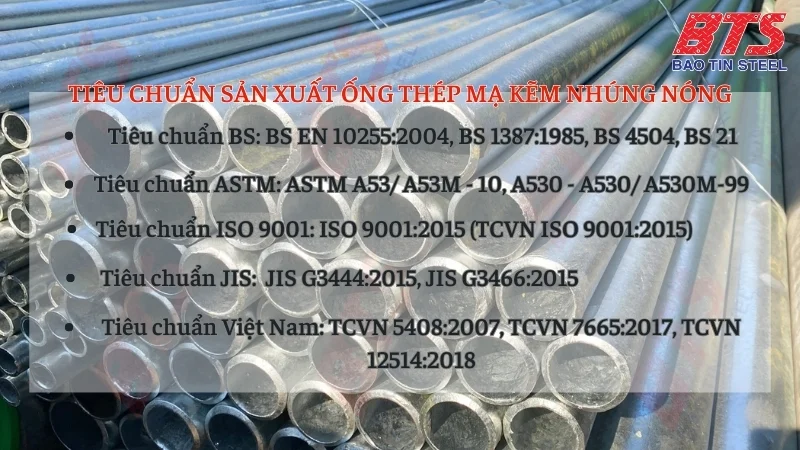
The most popular hot-dip galvanized steel pipe standards are the American standard ASTM, the British standard BS EN, and the Vietnamese standard. With each standard, the chemical composition and mechanical properties of steel pipes will be different.

British Standards – BS
This is a set of standards issued by the British Standards Institute (BSI). BS is the abbreviation for British Standards, meaning British Standards. This set of standards applies to many products in many different fields, including the iron and steel industry. Specifically, for steel pipes, this set of standards will regulate parameters, pipe types, and quality. Black steel pipe products, welded steel pipes, galvanized steel pipes, hot-dip galvanized steel pipes, etc. must all comply with these BS standards.

In this article, we are talking about hot-dip galvanized steel pipes. Therefore, the standards mentioned will revolve around this type of steel pipe. Let’s take a look at the standards in the BS standards that are applied to hot-dip galvanized steel pipes:
- The standard for thread pitch of steel pipes: BS 21
- Standard for steel pipe flanges: BS 4504
- The standard for steel pipes with or without threads: BS 1387 – 1985
- Technical standard for welded steel pipes: BS EN 10255:2004
European Standard BS EN 10255:2004 (BS 1387:1985)
| Chemical composition | Mechanical properties | ||||||
| Cmax | Mn max | P max | S max | Durable flow – ReH min (Mpa) | Tensile strength – Rm (Mpa) | Elongation – Amin (%) | Zinc layer thickness – T (μm) |
| 0,2 | 1,4 | 0,035 | 0,03 | 195 | 320 ÷ 520 | 20 | 40÷80 |
| Specifications | Tolerances | ||||||
| Outer diameter | D (21,3 ÷ 114,3) mm | ± 1% | |||||
| Wall thickness | T (2,0 ÷ 4,5) mm | ± 10% | |||||
| Weight | Kg/m | ± 8% | |||||
| Length | L = 6000mm | ± 12mm | |||||
See more related articles:
- Hoa Phat galvanized steel pipe standards
- Hoa Phat steel pipe catalog 2024 – No. 1 market share in Vietnam
- Specifications and weight of Hoa Phat galvanized steel pipes
American Standard – ASTM

ASTM is the acronym for the American Society for Testing and Materials. This set of standards currently has 12,575 standards applicable to 15 different fields, including the steel industry. The main topics of this standard include:
- Technical performance standards.
- Standards on testing and testing methods.
- Standards of practice.
- Instructional standards.
- Classification standards.
- Standard terminology.
Some outstanding standards are in the US ASTM standards for hot-dip galvanized pipes:
- ASTM A53/A53M-10: Piping Specifications
- A530 – A530 / A530M-99: Technical standard for general requirements of specialized carbon and alloy steel pipes.
ASTM A53/A53M-12 standard lookup table
| Chemical composition | Mechanical properties | ||||||
| Cmax | Mn max | P max | S max | Durable flow – ReH min (Mpa) | Tensile strength – Rm (Mpa) | Elongation – Amin (%) | The thickness of the zinc layer – T (μm) |
| 0,25 | 0,95 | 0.05 | 0,045 | 205 | 330 | 24 | 40÷80 |
| Specifications | Tolerances | ||||||
| Outer diameter | D (21,3 ÷ 114,3) mm | ± 1% | |||||
| Wall thickness | T (2,6 ÷ 4,5) mm | ± 12,5% | |||||
| Weight | Kg/m | ± 10% | |||||
| Length | L = 6000mm | ± 12mm | |||||
Japanese standards – JIS

JIS is the Japan Industrial Standard. This set of standards applies to industrial activities taking place in this country. The standardization process is directed by the Japan Industrial Standards Committee (JISC) and published through the Japan Standards Association (JSA).
To classify JIS standards, people have added one capital letter as a symbol to divide the fields. In particular, the steel pipe fields are unified as JIS B and JIS G. For example: JIS G 3455 applies to high-pressure carbon steel pipes. Or with hot-dip galvanized pipes, we have:
- JIS G3444: 2015: Carbon steel pipe standard for general structures
- JIS G3466: 2015: Carbon Steel Square and Rectangular Pipe Standard for General Structures
Standard lookup table JIS G3444:2015/ JIS G3466:2015
| Chemical composition | Mechanical properties | ||||||
| Cmax | Mn max | P max | S max | Durable flow – ReH min (Mpa) | Tensile strength – Rm (Mpa) | Elongation – Amin (%) | Zinc layer thickness – T (μm) |
| 0,25 | 0,04 | 0,04 | 235 | 400 | 18 | 12÷27 | |
| Specifications | Tolerances | ||||||
| Outer diameter | D (21,2 ÷ 126,8) mm | D <50mm ± 0,5mm; ≥50mm ±1% | |||||
| Wall thickness | T (1,5 ÷ 3,0) mm | ± 12,5% T <4mm ± 0,6mm / -0,5mm | |||||
| Weight | Kg/m | ± 5% | |||||
| Length | L = According to order | ± 20mm | |||||
International Standard ISO 9001

This is a set of standards issued by the International Organization for Standardization (ISO)) since 1987. Up to now, the ISO 9001 standard set has been adjusted and supplemented four times. Each time, we have versions like ISO 9001:1994; ISO 9001:2000; ISO 9001:2008; and ISO 9001:2015.
The ISO 9001:2015 standard is applied as a framework for a quality management system. At the same time, it is also used to evaluate certification under the quality management system of any organization.
Vietnamese standards – TCVN

- TCVN 5408:2007 (ISO 01461:1999): Standard Hot-dip Zinc Coating on the Surface of Cast Iron and Steel Products: Technical Requirements and Test Methods
- TCVN 7665:2007 (ISO 1460:1992): Standard on Metal Coatings; Hot-dip galvanized coating on ferrous materials; Determination of coating mass per unit area
- TCVN 12514:2018 – Zinc-coated steel used for concrete reinforcement

How are hot-dip galvanized steel pipes produced?
Hot-dip galvanized steel pipe refers to steel pipes whose surface is coated with a layer of zinc 55 µm ~ 85 µm thick.
To be called hot-dip galvanized steel pipes, the steel pipes must be dipped in molten zinc solution. Specifically, how does this zinc dipping process take place? Please read on!
Depending on the manufacturer, the processing process of hot-dip galvanized steel pipe will vary in a few stages.
Below, Bao Tin Steel will provide the production processes of two companies, Hoa Phat and SeAH.
Hoa Phat hot-dip galvanized steel pipe production process

Normally, other products that can be hot-dip galvanized need to go through the process of cleaning the surface and dipping into a flux solution. The purpose is to remove rust, remove the iron oxide layer on the surface, and prevent further chemical reactions from occurring.
However, with Hoa Phat brand hot-dip galvanized pipes, it is different. During the metallurgical process, the steel was dipped in flux, and rust was removed in the rolling stage of rolling steel into sheets.
After being shaped, high-frequency welded, and welded, the steel pipe will be sent directly to the tank containing molten zinc solution.
- Zinc solution has a temperature of 419.5 °C (melting point of Zn). After steel pipes are immersed in molten zinc, the electrochemical process (the nature of metal corrosion) will occur.
- And because Zn is a more electrochemical substance than steel, steel will become a cathode and quickly attract zinc ions (Zn2+). Zinc ions accumulate, forming a zinc layer that covers the entire surface of the steel pipe.
- The hot-dip galvanizing process ends when the inner layer of the steel pipe reaches 75% zinc and 25% steel, and the outer layer is 100% zinc.
Then the steel pipe is removed from the plating tank. Rapid cooling and quality testing are performed.
SeAH hot-dip galvanized pipe production process

How many types of hot-dip galvanized steel pipes are there?
1. Sort by manufacturer

Currently on the market, there are many manufacturers of hot-dip galvanized steel pipes, including::
- Visa Steel Import-Export Trading Company Limited. Quality meets ISO 9001:2015, ASTM A500/ A500M-07, and BS EN 10255:2004 standards. With a production capacity of over 400,000 tons/year.
- Hoa Phat Group. Quality meets ASTM A53/A53M, ASTM A500/A500M, TCVN, ISO 9001:2015, BS EN 10255:2004 standards.
- eAH Vietnam Steel Company Limited.
- VinaOne Steel Production Joint Stock Company. Manufactured according to ASTM A53, ASTM A795, BS 1387, and BS EN 10255 standards.
- Hoa Sen Group. Hot-dip galvanized steel pipes are manufactured according to standards BS 1387, BS EN 10255 (Europe), ASTM A53/A53M-12 (USA), AS 1074 (Australia) and MS 863 (Malaysia).
- Along with other manufacturers from China.
2. Sort by size
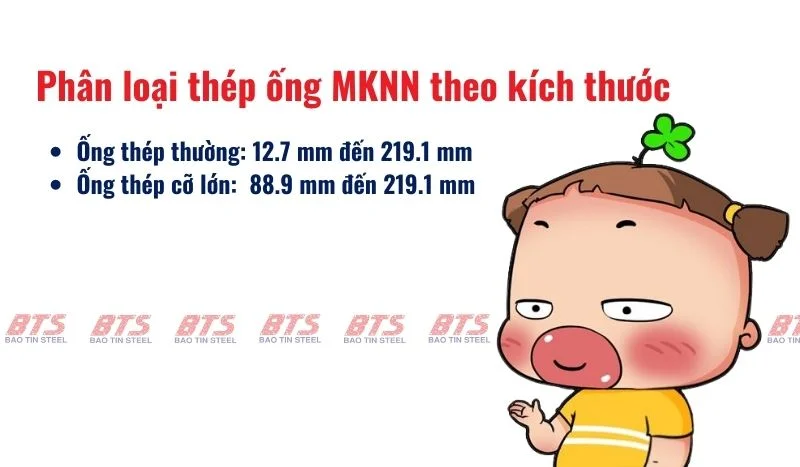
- Types of hot-dip galvanized steel pipes on the market usually have an outer diameter of 12.7 mm to 219.1 mm for regular pipes.
- For large types of hot-dip galvanized steel pipes, the size will be 273 mm or more.
3. Classification of hot-dip galvanized steel pipes according to quality

During the production process, there will certainly be errors. And that is the basis for classifying steel in general and hot-dip galvanized steel pipes in particular.
On the market we can find the following types of steel pipes:
- Grade 1 genuine steel pipes: are products that, when tested and evaluated, meet the quality requirements and criteria.
- Type 2 hot-dip galvanized steel pipes: these products often suffer from minor aesthetic errors or shortcomings in specifications (size, thickness, galvanized surface, …).
- Hot-dip galvanized steel pipes have been used, but the damage is not high.
Hot dip galvanized steel pipe price quote updated 2024

| SPECIFICATIONS | THICKNESS | KG/LENGTH | UNIT PRICE | TOTAL AMOUNT |
|---|---|---|---|---|
| (Đ/Kg) | (Đ/length) | |||
| φ 21 | 1.6 mm | 4.642 | 26,000 | 120,692 |
| 1.9 mm | 5.484 | 26,000 | 142,584 | |
| 2.1 mm | 5.938 | 26,000 | 154,388 | |
| 2.3 mm | 6.435 | 26,000 | 167,310 | |
| 2.6 mm | 7.26 | 26,000 | 188,760 | |
| φ 26,65 | 1.6 mm | 5.933 | 26,000 | 154,258 |
| 1.9 mm | 6.961 | 26,000 | 180,986 | |
| 2.1 mm | 7.704 | 26,000 | 200,304 | |
| 2.3 mm | 8.286 | 26,000 | 215,436 | |
| 2.6 mm | 9.36 | 26,000 | 243,360 | |
| φ 33,5 | 1.6 mm | 7.556 | 26,000 | 196,456 |
| 1.9 mm | 8.888 | 26,000 | 231,088 | |
| 2.1 mm | 9.762 | 26,000 | 253,812 | |
| 2.3 mm | 10.722 | 26,000 | 278,772 | |
| 2.5 mm | 11.46 | 26,000 | 297,960 | |
| 2.6 mm | 11.886 | 26,000 | 309,036 | |
| 2.9 ly | 13.128 | 26,000 | 341,328 | |
| 3.2 mm | 14.4 | 26,000 | 374,400 | |
| φ 42,2 | 1.6 mm | 9.617 | 26,000 | 250,042 |
| 1.9 mm | 11.335 | 26,000 | 294,710 | |
| 2.1 mm | 12.467 | 26,000 | 324,142 | |
| 2.3 mm | 13.56 | 26,000 | 352,560 | |
| 2.6 mm | 15.24 | 26,000 | 396,240 | |
| 2.9 mm | 16.87 | 26,000 | 438,620 | |
| 3.2 mm | 18.6 | 26,000 | 483,600 | |
| φ 48,1 | 1.6 mm | 11 | 26,000 | 286,000 |
| 1.9 mm | 12.995 | 26,000 | 337,870 | |
| 2.1 mm | 14.3 | 26,000 | 371,800 | |
| 2.3 mm | 15.59 | 26,000 | 405,340 | |
| 2.5 mm | 16.98 | 26,000 | 441,480 | |
| 2.6 mm | 17.5 | 26,000 | 455,000 | |
| 2.7 mm | 18.14 | 26,000 | 471,640 | |
| 2.9 mm | 19.38 | 26,000 | 503,880 | |
| 3.2 mm | 21.42 | 26,000 | 634,920 | |
| 3.6 mm | 23.71 | 26,000 | 616,460 | |
| φ 59,9 | 1.9 mm | 16.3 | 26,000 | 423,800 |
| 2.1 mm | 17.97 | 26,000 | 467,220 | |
| 2.3 mm | 19.612 | 26,000 | 509,912 | |
| 2.6 mm | 22.158 | 26,000 | 576,108 | |
| 2.7 mm | 22.85 | 26,000 | 594,100 | |
| 2.9 mm | 24.48 | 26,000 | 636,480 | |
| 3.2 mm | 26.861 | 26,000 | 698,386 | |
| 3.6 mm | 30.18 | 26,000 | 784,680 | |
| 4.0 mm | 33.1 | 26,000 | 860,600 | |
| φ 75,6 | 2.1 mm | 22.85 | 26,000 | 594,100 |
| 2.3 mm | 24.96 | 26,000 | 648,960 | |
| 2.5 mm | 27.04 | 26,000 | 703,040 | |
| 2.6 mm | 28.08 | 26,000 | 730,080 | |
| 2.7 mm | 29.14 | 26,000 | 757,640 | |
| 2.9 mm | 31.37 | 26,000 | 815,620 | |
| 3.2 mm | 34.26 | 26,000 | 890,760 | |
| 3.6 mm | 38.58 | 26,000 | 1,003,080 | |
| 4.0 mm | 42.4 | 26,000 | 1,102,400 | |
| φ 88,3 | 2.1 mm | 26.8 | 26,000 | 696,800 |
| 2.3 mm | 29.28 | 26,000 | 761,280 | |
| 2.5 mm | 31.74 | 26,000 | 825,240 | |
| 2.6 mm | 32.97 | 26,000 | 857,220 | |
| 2.7 mm | 34.22 | 26,000 | 889,720 | |
| 2.9 mm | 36.83 | 26,000 | 957,580 | |
| 3.2 mm | 40.32 | 26,000 | 1,048,320 | |
| 3.6 mm | 45.14 | 26,000 | 1,173,640 | |
| 4.0 mm | 50.22 | 26,000 | 1,305,720 | |
| 4.5 mm | 55.8 | 26,000 | 1,450,800 | |
| φ 114 | 2.5 mm | 41.06 | 26,000 | 1,067,560 |
| 2.7 mm | 44.29 | 26,000 | 1,151,540 | |
| 2.9 mm | 47.48 | 26,000 | 1,234,480 | |
| 3.0 mm | 49.07 | 26,000 | 1,275,820 | |
| 3.2 mm | 52.58 | 26,000 | 1,367,080 | |
| 3.6 mm | 58.5 | 26,000 | 1,521,000 | |
| 4.0 mm | 64.84 | 26,000 | 1,685,840 | |
| 4.5 mm | 73.2 | 26,000 | 1,903,200 | |
| 5.0 mm | 80.64 | 26,000 | 2,096,640 | |
| φ 141.3 | 3.96 mm | 80.46 | 27,000 | 2,172,420 |
| 4.78 mm | 96.54 | 27,000 | 2,606,580 | |
| 5.16 mm | 103.95 | 27,000 | 2,806,650 | |
| 5.56 mm | 111.66 | 27,000 | 3,014,820 | |
| 6.35 lmm | 126.8 | 27,000 | 3,423,600 | |
| φ 168 | 3.96 mm | 96.24 | 27,000 | 2,598,480 |
| 4.78 mm | 115.62 | 27,000 | 3,121,740 | |
| 5.16 mm | 124.56 | 27,000 | 3,363,120 | |
| 5.56 mm | 133.86 | 27,000 | 3,614,220 | |
| 6.35 mm | 152.16 | 27,000 | 4,108,320 | |
| φ 219.1 | 3.96 mm | 126.06 | 27,000 | 3,403,620 |
| 4.78 mm | 151.56 | 27,000 | 4,092,120 | |
| 5.16 mm | 163.32 | 27,000 | 4,409,640 | |
| 5.56 mm | 175.68 | 27,000 | 4,743,360 | |
| 6.35 mm | 199.86 | 27,000 | 5,396,220 |
Note: The price list above is for reference only; it does not include VAT, shipping fees, discounts, etc. Price quotes may change from time to time. By the time you read the article, there may have been a slight price difference. Therefore, you should only refer to it. If you want to receive the most accurate quote, please contact 0932059176.
The difference between hot-dip galvanizing and regular galvanizing
Previously, we learned about three common ways to galvanize steel, but today, below, we will learn more about how to distinguish between hot-dip galvanizing and regular galvanizing.

The same point
- Both are of the zinc plating type.
- All done with important processes in plating. Specifically, cleaning materials, removing lubricants, etc.
- Shiny appearance, increasing the aesthetics of the finished product.
Although there are similarities in the process and equipment used, However, they still have distinct characteristics, suitable for specific applications, and different technical requirements.
Differences
- Electrolytic zinc plating is a type of spraying the plating layer directly onto the surface, with a short plating time of about 5–15 minutes. Electrolytic zinc plating has the advantage of high adhesion, often using the cold plating method. Therefore, when used to galvanize steel pipes or steel boxes, the outer surface can only be plated, but the inside cannot be fully covered because the spray cannot reach it.
- Hot-dip galvanizing was mentioned above, it has a hot-dip galvanizing time of about 30-45 minutes, creating a uniform and comprehensive coating.
-> In terms of price, electrolytic plating will cost less than hot-dip galvanizing because the galvanized layer of hot-dip pipes is thicker.
As mentioned above, hot-dip galvanized pipes are resistant to corrosion and have a long life, so they are used in many applications. Some common applications include construction steel pipes, scaffolding, fences, fire protection pipes, liquid and gas pipes, stair railings, household appliances, etc.
Conclude
What is a hot-dip galvanized steel pipe? Hot-dip galvanized steel pipes are steel pipes coated with zinc on the outside. Therefore, it can overcome rust phenomena. Buy hot-dip galvanized pipe products from reputable, quality suppliers for long-term use, efficiency, and cost savings. Please contact Bao Tin Steel to have your questions answered, receive a quote, and place an order as soon as possible!