

 Tiếng Việt
 ភាសាខ្មែរ
The formula for calculating the volume of a round flange is always of great interest to technicians, especially those new to the profession. Understanding this formula will allow us to calculate and choose the appropriate flange type for the pipeline. Thereby limiting problems that may occur while the system is operating. See Bao Tin Steel’s article now to gain more useful knowledge!
Which round flange does the pipe use?
Types of hollow flanges commonly used in pipeline systems include:
- Flat flange: This flange has a simple structure, is easy to install, and has an affordable price. This flange can withstand low pressure and is only suitable for pipes with little strong vibration.
- Neck flange: This flange has high hardness and can withstand high pressure. Therefore, it is used in systems with high pressure and requiring high safety.
- Groove flange: This flange has better sealing ability than the two types of flanges mentioned above. Therefore, it is often used for high-viscosity fluid systems.
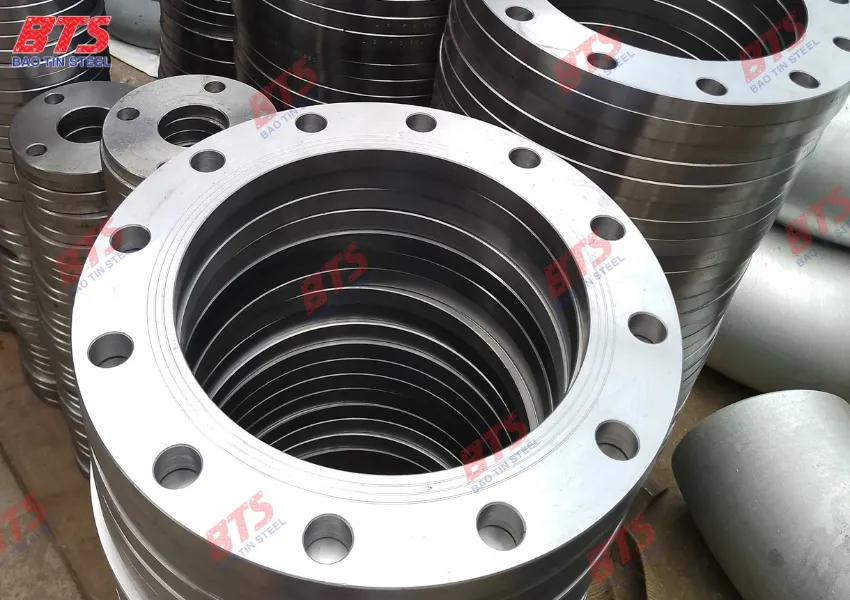
How to calculate the volume of the round flange
As mentioned, 3 types of flanges are commonly used in pipeline connections: flat flanges, neck flanges, and groove flanges. Before starting to calculate the flange volume, you still need to be provided with data about the diameter and density of the flange manufacturing material. In particular, the average density of some common flange materials is:
- Steel: 7.85 g/cm³
- Stainless steel: 7.93 g/cm³
- Cast iron: 7.2 g/cm³
These are basic parameters to help you calculate flange weight more easily. Below is the formula to calculate specific flange weight:
The formula for calculating flat flange volume
M = (π/4 * (D² – d²) * t) * ρ
In there:
- M: Mass of flange (kg)
- D: Flange outer diameter (mm)
- d: Flange inner diameter (mm)
- t: Flange thickness (mm)
- ρ: Flange material density (kg/cm³)

The formula for calculating the volume of the neck flange
M = (π/4 * (D² – d²) * t) * ρ + (π/4 * d² * t1) * ρ
In there:
- M: Mass of flange (kg)
- D: Flange outer diameter (mm)
- d: Flange inner diameter (mm)
- t: Flange thickness (mm)
- t1: Flange neck thickness (mm)
- ρ: Flange material density (kg/cm³)

>> A complete piping system will have a combination of both flanges and flange fittings. The size of pipes and accessories also affects the weight of the flange.
The formula for calculating the volume of grooved flanges
M = (π/4 * (D² – d²) * t) * ρ + (π * d * t1 * b) * ρ
In there:
- M: Mass of flange (kg)
- D: Flange outer diameter (mm)
- d: Flange inner diameter (mm)
- t: Flange thickness (mm)
- t1: Flange groove thickness (mm)
- b: Flange groove width (mm)
- ρ: Flange material density (kg/cm³

Note when calculating the weight of round flanges
- The above formulas only apply to calculating the volume of round flanges. If other types of flanges have other shapes, a different formula will have to be applied.
- There are many materials for making flanges. Careful checks should be made to apply the appropriate material density to ensure accurate calculations.
- The above-calculated volume is only theoretical volume. Actual flanges will sometimes have a slightly higher or lower weight due to machining tolerances.
Above is the formula for calculating round flanges that Bao Tin Steel suggests. Hopefully, these shares will help you gain more useful knowledge. At the same time, support you a lot in your work. Contact Bao Tin Steel now if you want to buy quality flanges: 0932 059 176!