

 Tiếng Việt
 ភាសាខ្មែរ
RF (raised face) and FF (flat face) flanges are two types of flanges commonly used in piping systems and industrial equipment. So what are RF and FF flanges?
In this article, we will delve deeper into these two types of flanges. Also, compare the differences between them to help you better understand them and choose the right frame for your applications.
What is an RF flange?
Raised Face Flange (RF) is a type of flange that has a small raised part around the circumference of the flange. You can call this raised part the “flange” of the flange.
This design is intended to help the RF flange concentrate more pressure onto a smaller gasket area. This increases the pressure-blocking ability of the flange and helps RF flanges have a better sealing surface than flat flanges. At the same time, it can help prevent leaks and improve overall joint performance.
Lifting flanges are commonly used in medium- to high-pressure applications. Such as in pipelines, refineries, and petrochemical plants. They are available in many sizes and materials, including carbon steel, stainless steel, and alloy steel. To suit different applications and operating conditions.
Diameter and height are determined under ASME B16.5 according to pressure class and diameter. The pressure rating of the flange determines the height of the raised face.
The typical flange surface for ASME B16.5 RF flanges is 125 to 250 mm in Ra (3 to 6 mm in Ra).
- At pressure levels 150 and 300, the height of the raised face is approximately 1.6 mm (1/16 inch).
- At pressure classes 400, 600, 900, 1500, and 2500, the height of the raised face is approximately 6.4 mm (1/4 inch)..

What is an FF flange?
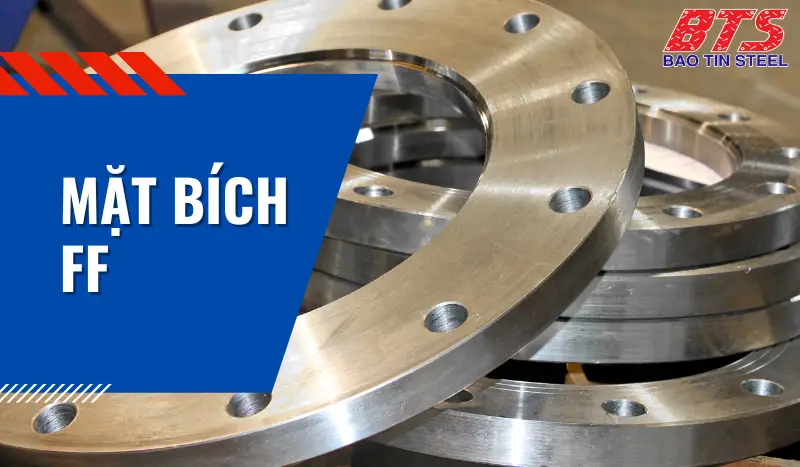
FF (Flat Face) flange is a 2-sided flange with a flat and smooth surface on both sides (no burrs). When connecting between two flanges, people often use non-metallic (soft) gaskets (washers).
Unlike RF-raised flanges, FF flat flanges do not have raised sections around the circumference of the flange.
Flat flanges are often used in low-pressure applications where tightness requirements are not so important.
They are also commonly used in applications where flanges of all types need to be tightly connected. Because the flat surface provides a more uniform clamping force than a raised flange.
Flat flanges come in a variety of sizes and materials, including:
- Steel flange
- Stainless steel flange
- Alloy steel flange
To suit different applications and operating conditions.
They are commonly used in industries such as water and wastewater treatment, HVAC, and general plumbing applications. Applications that use flat flanges are typically those in which the mating flange or flange joint is produced by casting.
Flat flanges should never be bolted to raised flanges. ASME B31.1 mentions that when connecting cast iron flat flanges to carbon steel raised flanges. The raised face of the carbon steel flange must be eliminated and a full-face gasket is required. This is to keep the small, thin cast iron flange from popping into the gap caused by the raised face of the carbon steel flange.
Compare RF and FF flanges
Comparison table of RF Flange and FF Flange
| Comparison point | Raised Face Flange | Flat Face Flange |
|---|---|---|
| Flange surface | There is a small lift around the flange | Bề mặt bằng và trơn tru |
| Application | Medium to high pressure | Áp suất thấp |
| Bolt clamping force | Less uniform | Lực kẹp đồng đều hơn |
| Connection durability | More resistant to pressure | Độ bền kết nối thấp hơn |
| Dimensions and materials | Available in many sizes and materials | Có sẵn trong nhiều kích thước và vật liệu |

What are the similarities of RF and FF flanges:
- All types of flanges are used to connect pipes or other equipment in industrial applications.
- Both types of flanges are available in a variety of sizes and materials. To suit the specific requirements of the application.
What are the differences between RF and FF flanges:
- The raised Face Flange has a small raised section around the flange. While the Flat Face Flange has a flat and smooth surface.
- Raised Face Flange is typically used in medium to high-pressure applications. While Flat Face Flange is commonly used in low-pressure applications.
- Flat flanges provide a more uniform clamping force than raised flanges.
- A raised Face Flange is more resistant to pressure than a Flat Face Flange.
- The connection strength of the Raised Face Flange is higher than that of the Flat Face Flange.
To summarize, RF and FF flanges are both indispensable parts of piping systems and industrial equipment. Choosing the right flange for the specific application is very important. To ensure system performance and safety. Including a selection of flange fabrication material & proper dimensions.